Traffic through the waterway has reportedly slightly increased, though the passage is still fraught with immense risks
The Strait of Hormuz – a critical chokepoint accounting for 20% of seaborne oil trade prior to the US-Israeli war against Iran – remains effectively blocked despite the tentative ceasefire. The traffic has ground to a halt due to the risks posed by mines, recurring attacks, and ship seizures, as well as insurers’ reluctance to step in.
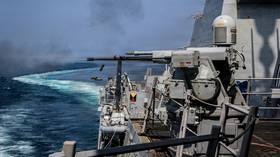
The US maintains its own blockade on Iranian ports, with NATO countries reportedly considering taking on a role in escorting ships in the area.
Despite the severe disruption, media reports suggest a slight uptick in traffic through the strait, with Iran reportedly offering a Bitcoin-based scheme to provide insurance to shipping companies.
Here are the most recent developments in the Strait of Hormuz.
NATO Hormuz intervention?
On Tuesday, Bloomberg reported, citing a senior official, that NATO is mulling the possibility of escorting ships if the strait is not reopened by early July, though the idea does not yet have unanimous backing in the US-led military bloc.
NATO has been split over the US-Israeli war against Iran – deepening US President Donald Trump’s ire towards the bloc’s European members, who have signaled that they could take part in ensuring maritime security after the sides reach a sustainable peace.
It is unclear how NATO would be able to step in even if a consensus is reached, Bloomberg noted, given that the US has not been able to establish control over the strait.

Iran develops shipping insurance
On Monday, Fars news agency reported that Iran launched a Bitcoin-based shipping insurance service – ‘Hormuz Safe’. The government says the scheme will provide “fast, verifiable digital insurance” while generating an estimated $10 billion in revenue.
CoinDesk expressed skepticism, citing factors complicating passage, as well as the possibility of US sanctions on companies that accept the offer. According to Iranian media, the insurance would cover detention, inspection, and cargo confiscation, but not damage from weapons.
The scheme has also been interpreted as another attempt to establish a toll regime in the strait – which the US said it would not accept under any circumstances.
A previous US attempt to guarantee insurance for shipping companies ended in failure. Early in the conflict, Trump announced that he ordered the US Development Finance Corporation (DFC) to provide up to $40 billion in reinsurance for all shipping through the Gulf, with Chubb, AIG, and Berkshire Hathaway named as backers.
According to the Financial Times, the program did not provide a single dollar of coverage because the precondition of US naval escort was not met.
Has traffic through the Strait of Hormuz increased?
While the current traffic through the chokepoint remains a fraction of that before the war, Lloyds List reported on Monday that at least 54 vessels – including ten Chinese-linked vessels – transited through the strait last week – more than double than a week prior. Before the war, around 3,000 vessels crossed the strait every month, compared to 191 in April.
The apparent increase came after Iranian media reported that Iran began allowing some Chinese vessels to transit through the Strait of Hormuz after the two countries reached an understanding on Iranian management protocols for the waterway. Tehran also earlier signaled it would allow passage to ships not linked to the US and Israel.
On Wednesday, Bloomberg reported, citing a source familiar with the matter, that India – which imports around 55% of its oil from the Gulf – is preparing to send vessels through the strait to load up energy cargoes. According to the agency, the plans are in the final stage.
Iranian officials claimed on Wednesday that they coordinated the transit of 26 vessels through the waterway over the past 24 hours.
Is the Strait of Hormuz still dangerous?
Last week’s modest traffic uptick was accompanied by renewed violence. On May 14, a Honduras-flagged ‘floating armory’ named Hui Chuan, which stored weapons and ammunition for security companies and anchored near the port of Fujairah, was seized by unauthorized personnel and towed to Iranian waters.
Around the same time, an Indian-flagged livestock barge, Haj Ali, was struck by a “major explosion” – likely caused by a drone or missile attack – and sank off the coast of Oman, with all crew members rescued.
In total, as of last week, the United Kingdom Maritime Trade Operations (UKMTO) reported 49 incidents in the region, with 27 classified as attacks.
What crucial cables lie in the Strait of Hormuz?
The stand-off in Hormuz could also impact global telecom networks. Iranian military spokesman Ebrahim Zolfaghari warned this month that Tehran “will impose fees on internet cables.” Iranian media also signaled that the measure would include licensing fees and annual “protection payments” from major tech companies including Meta, Amazon, and Microsoft. These companies, however, are obliged to follow US sanctions that prohibit them from engaging in business with Iran.
At least eight major telecom cables lie on the strait’s bed, with many of them spanning thousands kilometers from Europe to China, and are owned by dozens of international companies, according to submarinecablemap.com.
Will the US and Iran be able to reopen the Strait of Hormuz?
The outcome of the crisis ultimately depends on whether the US and Iran are able to bridge their numerous differences, and so far they seem to be as far from a deal as ever.
On Monday, Axios reported, citing sources, that Iran submitted a new peace proposal, but the White House considered it insufficient: “We are really not making a lot of progress… We need some real, sturdy, and granular conversation [regarding the nuclear program]. If that’s not gonna happen, we will have a conversation through bombs, which will be a shame,” an unnamed US official told the outlet.
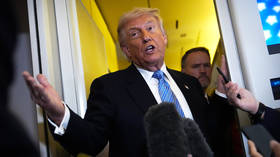
The same day, Trump said he was planning a “very major attack” on Iran for Tuesday but canceled it after being approached by several Gulf states which implored him to give diplomacy a chance.
“For Iran, the clock is Ticking, and they better get moving, FAST, or there won’t be anything left of them,” he warned.
Iran – which has denied that it seeks to develop nuclear weapons – has insisted that a peaceful settlement should include the cessation of hostilities against both Iran and Hezbollah, a US military withdrawal from the region, the lifting of all sanctions, and reparation for damages.
The US has demanded that Iran dismantle its nuclear program, surrender its stockpile of enriched uranium, and lift any restrictions on traffic through the Strait of Hormuz.