Spain Ignores EU and Prepares Urgent Transfer of 500 Migrant Girls from Ceuta to Mainland
By Maria Muñoz Morillo
Pedro Sánchez’s government is planning the urgent transfer to mainland Spain of 500 migrant girls who arrived in Ceuta, while the EU supports sending the unaccompanied minors back to Morocco.
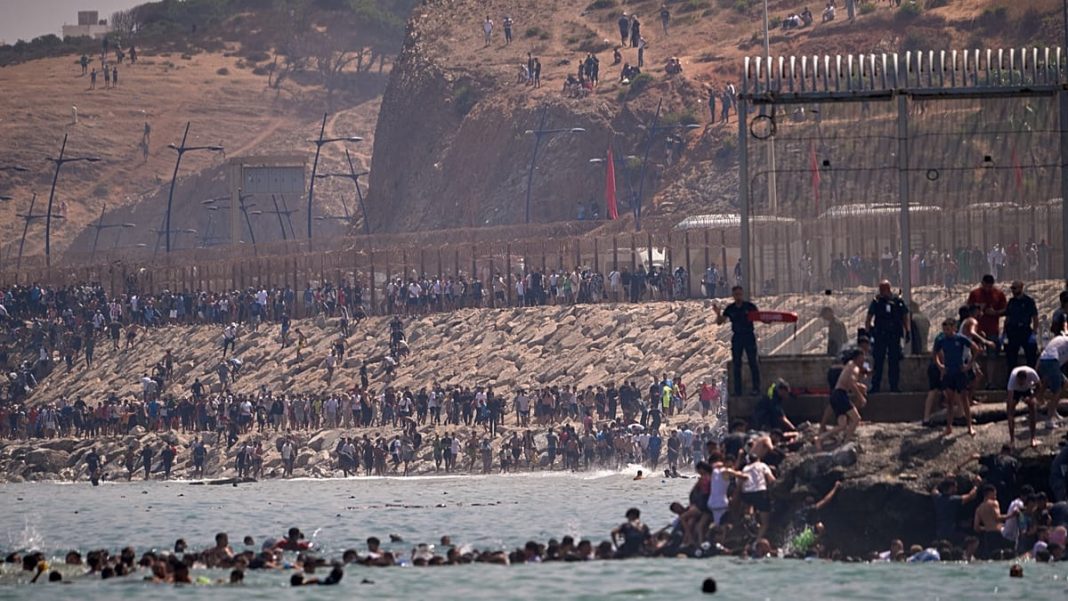
Although the central government insisted from the outset that no migrants would be transferred to the mainland, Spain has now decided to make arrangements for the transfer of 500 unaccompanied minors. According to Spain’s Ministry for Youth and Children, work is underway on the urgent transfer to mainland Spain of 500 migrant girls who arrived in Ceuta during the mass migrant influx between 30 and 31 July.
Sources at the ministry explain that “this plan includes the royal decree-law providing for compulsory, solidarity-based reception by all the autonomous communities, or family placement, as well as other mechanisms to speed up reception.”
Among the options being considered is a route that would allow child-protection organisations to manage the reception and care for the most vulnerable cases, including the girls, in tailored facilities on the mainland, without the need to transfer guardianship to the autonomous communities.
Several autonomous communities have already said they will not take in unaccompanied minors who arrived in the Ceuta mass crossing. The central government has criticised what it calls a lack of “solidarity” shown by these regions.
For its part, Morocco asked the Spanish government last week to return the Moroccan citizens still remaining in the enclave.
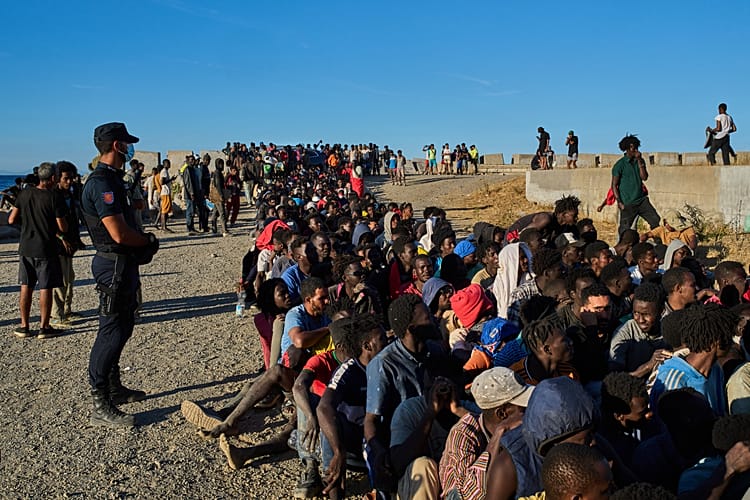
Migrants who crossed from Morocco into Spain line up for food distribution on a beach in the Spanish enclave of Ceuta, 3 August, 2026
Protecting the best interests of the child
Elma Saiz, Minister for Inclusion, Social Security and Migration, told the public broadcaster RNE that the issue is being addressed by Ceuta together with the Department for Children and the autonomous communities. She preferred not to give further details, but insisted on the need to “protect the best interests of the children.”
The politician stressed that “these are girls who are on their own.” She said the minors have been grouped together in safe spaces in Ceuta to prevent cases of sexual violence, after numerous rapes were reported in recent days, which are already being investigated.
Saiz underlined the need to respect the law and said the government has given Ceuta €25 million to help deal with this situation.
The national police have identified and handed over 2,168 minors to the Ceuta government as of Tuesday, 18 August.
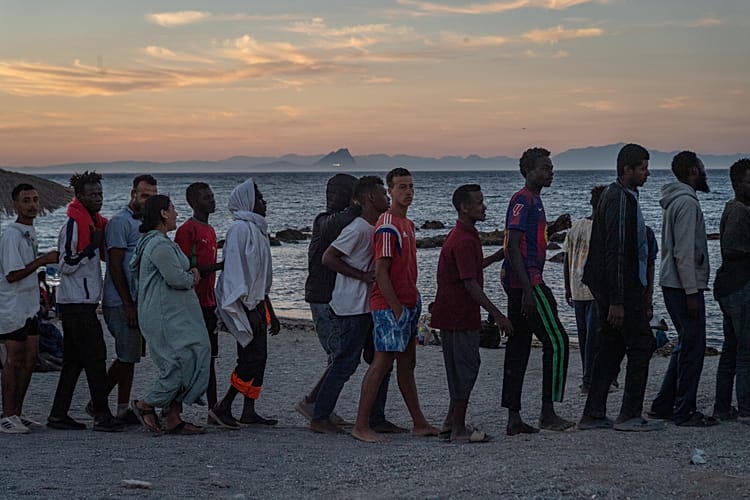
Migrants who crossed from Morocco into Spain line up for food distribution on a beach in the Spanish enclave of Ceuta, 3 August, 2026
Brussels supports sending all migrants back to Morocco
Meanwhile, the European Union is backing the return of unaccompanied minors from Ceuta to the African country.
“The priority now is for the Spanish and Moroccan authorities to keep the situation under control and guarantee the swift return of all those who remain irregularly in Ceuta,” European Commission spokesperson Markus Lammert said at a press conference on Tuesday. Lammert stressed that the returns are covered by EU law, adding that they are regulated by “the Return Directive” and, in future, by “the EU Return Regulation.”
The Ceuta Regional Government pointed out that it conveyed its position to the Secretary of State for Youth and Children, Rubén Pérez on Thursday, and that this is not an isolated stance.
The European Commission endorsed it on Tuesday through Commissioner Markus Lammert, who made it clear that the expectation is that all those residing illegally in Ceuta, including minors, will be returned.
This European backing clashes head-on with Wednesday’s announcement by the Ministry of Youth and Children, which is working on a comprehensive plan to accommodate the girls, including a possible royal decree obliging the autonomous communities to take responsibility for their care, as well as asking child protection organisations for support.
Ceuta insists it has not agreed to anything
The Ceuta Government is not backing down. Despite the decision by the Ministry of Youth and Children to transfer 500 migrant girls to the mainland, Juan Jesús Vivas’s administration insists that its objective has remained the same since July and stated that Morocco takes responsibility for all those who entered the country irregularly during the migrant influx, including minors.
According to Spanish media reports, the Ceuta government categorically denies having given the go-ahead to Yout Minister Sira Rego’s plan.
“We have not accepted anything,” he said.
“Our demand remains the same. We are calling for the return of everyone. Categorically.”
Only if that avenue were exhausted would other options come into play, he clarified, although for the moment “everything is up in the air”.
The PP demands that the agreements with Rabat be implemented
The plan has not taken long to meet with resistance. The PP’s Deputy Secretary for Finance, Housing and Infrastructure, Juan Bravo, rejected it outright.
“It is in the best interests of the child to be with their family,” he said.
Bravo pointed out that both Fernando Grande-Marlaska and Jose Manuel Albares had previously called for the return of all migrants, including the 2,168 children who, according to the Home Office, remain on Ceuta’s territory.
The PP leader went further and questioned whether the Government is truly acting in the best interests of the children, as Saiz claimed, when “there is a request from Morocco for the children to return”.
The PP is calling for adherence to the 2007 bilateral agreements with Rabat and the European Return Directive, pointing out that Morocco is on the EU’s list of safe countries. To this, they add a series of demands, including legal reforms to speed up future returns, more Frontex and immigration officers and a reinforcement of the state security forces and the armed forces in the autonomous city.
Original Source: https://www.euronews.com/my-europe/2026/08/19/spain-ignores-eu-and-prepares-urgent-transfer-of-500-migrant-girls-from-ceuta-to-mainland