U.S.-Iran Live Updates: Trump Announces “Crushing Economic Operation” on Iran with Talks in limbo
By Duarte Dias, Tucker Reals, Khaled Wassef, Frank Andrews
What to know about the Iran war today:
- President Trump on Wednesday announced a “crushing economic operation” on Iran, one he said would amount to “economic warfare.” Earlier, he said the U.S. might return to negotiations with Iran eventually but, he said, currently “the situation is so good.”
- The head of Iran’s armed forces on Wednesday renewed the country’s warning to Persian Gulf states not to assist the U.S. military, saying any help would amount to joining operations against the Islamic Republic.
- The United Arab Emirates said Wednesday it was suspending all trade and financial dealings with Iran after issuing its first warning to residents in weeks of an incoming missile threat on Tuesday.
Pentagon officials considering firing longtime Stars and Stripes publisher, sources say
Pentagon officials have discussed firing the longtime publisher of Stars and Stripes before his scheduled retirement, U.S. officials told CBS News, as the Trump administration strategizes an overhaul of the military news outlet partly funded by American taxpayers.
Max Lederer, who has served as the publisher of Stars and Stripes for 19 years, this week announced to colleagues his decision to retire on Sept. 30, citing fundamental differences with the Trump administration. Editor-in-Chief Erik Slavin has spoken publicly, including to CBS News, about disagreements with Pentagon leaders.
It was unclear when a decision on the news outlet’s leadership would be made. Spokespeople for the Defense Department didn’t immediately comment.
The outlet, which receives about 65% of its funding through the Defense Department, has long prided itself on its editorial independence from the public affairs apparatus at the Pentagon.
Iran’s parliament speaker visits Iraq amid tension over Iraqi oil exports
Iranian Parliament Speaker Mohammad Bagher Qalibaf arrived in Iraq for a three-day visit where he will meet with Iraqi officials and leaders of an Iran-backed political coalition.
Iran-backed Iraqi militias have launched drone attacks on U.S. military and diplomatic targets both within Iraq and abroad, piling pressure on Baghdad, which for years has delicately tried to maintain strong ties with both Washington and Tehran.
Qalibaf praised the country’s Tehran-backed militias, which he called the “resistance in Iraq,” describing them as a “key component of the country’s national power.”
His comments came even as the Iraqi government has been trying to disarm the militias that have long operated on their own even though they were nominally under state command.
Iraq is asking Iran to grant special status to Iraqi oil exports through the Strait of Hormuz because the country has been affected greatly by Iran’s war with the U.S. and needs to guard its economic interests, according to a statement from Iraqi Parliament Speaker Haibet al-Halbousi.
Iraq relies on oil revenues for roughly 90% of its budget, and most of its oil is exported through the strait.
Since the war erupted and Iran asserted control over the strait, halting most shipping traffic, Iraq has turned to alternate routes, including sending oil over land to Syria, which is less efficient and more expensive.
Trump announces “crushing economic operation” on Iran
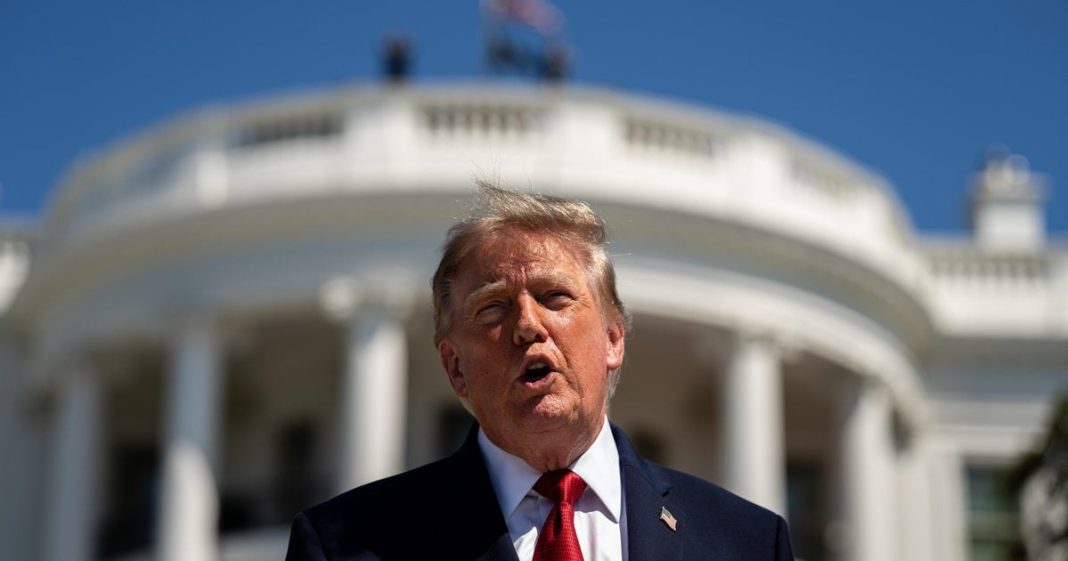
President Trump announced a “crushing economic operation” on Iran that he said will consist of “Economic Warfare and Isolation on an unprecedented scale.” He called it “an economic D-Day.”
“No one has given the Islamic Republic of Iran a greater opportunity to make a Deal than me. TRAGICALLY, for them, they have failed to take it,” the president wrote on Truth Social.
He also said any country that would “provide any type of lifeline to Iran” will face repercussions.
” … ANY country that allows its financial institutions, businesses, airports, or government entities to provide any type of lifeline to Iran will itself face TREMENDOUS Economic Consequences. Oil smuggling, swap lines, cash transfers, exchange houses, ship registries, front companies — It all needs to stop NOW. You know who you are,” Mr. Trump said.
The president said Iran is “on the ropes, and these HISTORIC MEASURES will cripple them and their ability to project terror worldwide,” reiterating that “IRAN WILL NEVER HAVE A NUCLEAR WEAPON.” ––––––––––––––––––––––––––––––––––––––––––––––––––––––––––––––––––––––––
Military newspaper Stars and Stripes publisher announces retirement, cites differences with Pentagon leadership
The longtime publisher of Stars and Stripes has announced his retirement, ending a decadeslong career with the military newspaper as Defense Secretary Pete Hegseth’s Pentagon moves to exert editorial control and eliminate what it asserts are “woke distractions.”
Max D. Lederer Jr. announced his retirement, effective at the end of September, in a memo to staff on Tuesday, as well as in an interview with Stars and Stripes. In the memo, seen by The Associated Press, Lederer, the second full-time civilian in the position, wrote that it had “become clear that my philosophy of leadership, and my understanding of the value and mission of Stars and Stripes, differ in fundamental ways from the direction the leadership of the Department of Defense has for the organization.”
The Pentagon did not immediately respond to a request for comment.
Stars and Stripes has recently been at the forefront of some of the reporting on conditions for sailors on the USS Abraham Lincoln and concerns for their mental health during the aircraft carrier’s long deployment — concerns that President Trump has downplayed.
Lederer’s announcement comes less than four months after the Pentagon fired Jacqueline Smith, ombudsman for the newspaper, whose job it was to safeguard editorial independence. The news outlet is partly funded by the Defense Department but has a legacy of independence from military and government leadership.
Trump says Strait of Hormuz blockade has been “extremely effective,” more sanctions against Iran possible
Speaking to reporters on Wednesday, President Trump said new sanctions against Iran are possible but the U.S. Navy’s blockade in the Strait of Hormuz has so far been “extremely effective.”
Asked about Treasury Secretary Scott Bessent‘s threat last week on unprecedented sanctions against Iran, Mr. Trump said: “We have things that we could sanction … We have very draconian sanctions.”
“It will either be extremely good and oil prices are gonna drop like a rock, or we’ll continue exactly what we’re doing,” the president said.
As the war with Iran continues and both sides seek to control the strait, through which 25% of the world’s oil trade transited before the war began in February, oil prices have reached their highest level since July.
Mr. Trump said Wednesday the Strait of Hormuz won’t be “as important as it was in the past,” adding that a record number of oil pipelines are being built.
At least seven major pipeline projects are under construction, in the planning stage or being discussed as possibilities, according to government officials, oil companies and analysts. However, it could be years before that oil could bypass the strait.
65 vessels redirected since Hormuz blockade restarted last month, U.S. military says
The U.S. military blockade on the Strait of Hormuz redirected one ship in the past day, bringing the total number of vessels prevented from exiting or entering Iranian ports to 65 since the blockade was restarted on July 14, according to U.S. Central Command.
President Trump has consistently touted the blockade as a reason he is not concerned over negotiations with Iran being on hold at the moment.
“There are no talks or conversations going on, or scheduled, with the Islamic Republic of Iran,” Mr. Trump wrote Tuesday on Truth Social. “The Naval Blockade remains in full force and effect. The Hormuz Strait is open and operating.”
There were just 10 commercial vessels confirmed to have transited the strait on Tuesday. However, the president discussed apparent U.S. efforts to get oil out of the strait with U.S. Navy assistance on Wednesday, saying it wasn’t perfect but plenty of oil was getting out.