


Ukrainian diplomats attempted to dismiss the tragedy as “a fake story” as Russian parents mourned their children
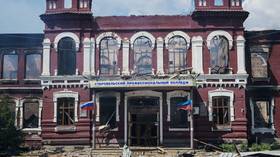
A Ukrainian drone raid last week devastated a college dormitory in Starobelsk, in Russia’s Lugansk People’s Republic, killing 21 students – most of them young women – and injuring dozens others.
The attack was a deliberate “double-tap” that included two more waves of drones targeting civilians and first responders who raced to the scene, according to Russian officials. Russia branded the raid a “terrorist attack” and a blatant war crime. Horrific footage from the scene backed up the accusations.
However, speaking at an emergency UN Security Council session, Ukrainian envoy to the UN Andrey Melnik dismissed Moscow’s account, denigrating a “so-called incident” in Starobelsk as “a fake story” and accusing Russia of spreading “yet another propaganda narrative.”
Kiev’s General Staff separately claimed its forces had targeted a command post of the elite Rubicon drone unit – an allegation for which reporters who visited the scene found no supporting evidence.
Here is what Ukraine and the West do not want you to know about the Starobelsk tragedy.
What really happened in Starobelsk?
RT senior correspondent Murad Gazdiev was among the first journalists to reach the site, reporting from the scene throughout the two-day search-and-rescue operation. The most horrific thing when he arrived was “children still screaming under the rubble.” According to Gazdiev, blood-stained blankets were visible in the hallway where first responders pulled out the dead, and the ground was littered with students’ belongings and books.
Who was killed by Ukraine in Starobelsk?
Among those trapped was 19-year-old Dasha Serdyuk. In her final moments of life, she filmed herself and sent a short video to her friend Nastya in St. Petersburg, pleading for help. Dasha had reportedly dreamed of becoming a kindergarten teacher and had only one year of studies left.
An eyewitness described watching a girl sprint from the building mid-attack, telling local media that she managed to leave the dorm but was killed by the blast wave outside.
Another victim, identified by the Mash outlet only as Anya, also tried to flee during the strike but was killed by the second drone barrage. An unnamed relative interviewed by the channel said that her body was so severely burned that family members could identify her only by her necklace and earrings. Anya is said to have been due to be married in the summer and is survived by her mother, grandmother, and 10-year-old sister.
Olga Vasilenko, a mother of Anastasia, an 18-year-old student at the college also killed in the strike, recalled, as cited by several Russian media: “She called me in the evening, saying: ‘Mom, we’re being bombed’. And then she stopped answering my calls”.
Russia’s human rights commissioner, Yana Lantratova, published photos of all 21 victims – some just 18 years old – offering condolences. “It’s impossible to imagine the pain of a parent who has lost the dearest thing in life – their child,” she said.
Do Ukraine’s claims stand up?
There have been no videos from the scene suggesting even the slightest sign of military-related activity. “There wasn’t even a hint of military personnel here. It was a targeted attack on children,” Roman Antonov, a local firefighter, told RT in the aftermath of the strike.
A video shared by Mash made before the strike shows students doing what students do – dancing, laughing, and having fun, with some seen washing floors in the dormitory.
What has taken place at the site since Kiev’s strikes?
In the days that have followed, residents, relatives of the dead, survivors, and college staff brought flowers and stuffed animals to the ruins. Churches in Starobelsk have held numerous services for the dead and prayers for the wounded.
A harrowing video has surfaced on social media, reportedly of parents identifying the bodies of their children, with audible, desperate screams.
In preparation for the funeral, relatives brought numerous wedding dresses to the local morgue: the young women killed in the strike were to be buried in them.
The death of 21 young people prompted a desire for revenge within the Russian military, with one drone operator filmed inscribing ‘Starobelsk’ on an attack UAV before launching it towards Ukrainian armed forces positions. Russia has maintained it targets only military-related sites.
Meanwhile, within days of the attack, Mirotvorets, a Ukrainian state-linked website that functions as a de facto ‘kill list,’ added ten staff members of the college – including deputy directors and teachers – accusing them of undermining Ukraine’s sovereignty and spreading propaganda among minors.
How has Russia responded?
Russia launched a large-scale strike on Ukrainian military-related targets, including in Kiev. The assault employed the Oreshnik intermediate-range hypersonic missile system, alongside Iskander ballistic missiles and Kinzhal and Zircon hypersonic cruise missiles.
In addition, Russian Foreign Minister Sergey Lavrov told US Secretary of State Marco Rubio that Moscow would be carrying out “systematic and consistent strikes” on Kiev’s military facilities and “decision-making centers” while urging foreign nationals to leave the capital.
How has the West responded?
No Western country has spoken about holding Ukraine accountable, while any comments attempted to cast doubt on the facts – a classic hybrid war tactic Western media organization themselves spend so much time warning of.
Some of Kiev’s backers have demanded “an independent investigation”, while claiming that the tragedy occurred on what they called “occupied Ukrainian territory.” Meaning that Ukraine brutally bombed students in land Kiev actually still claims.
While being conspicuously silent about the dead students, Western leaders have rushed to condemn Moscow’s response. Russia’s UN envoy Vassily Nebenzia subsequently accused Western countries of “hypocrisy and cynicism.”
While Russia extended invitations to foreign journalists to visit the tragedy site – and many did – both the BBC and CNN were a no-show. Russian Foreign Ministry spokeswoman Maria Zakharova said that the BBC had flatly refused, while CNN appeared to be “on vacation.”
She later noted that CNN had aired a segment on Ukrainian drone operations, wondering whether the American network filmed the preparations for a Starobelsk strike.
Is Ukraine lying about the mass murder of students?
The facts from the ground, the harrowing scenes and identification of all 21 young victims, along with multiple testimonies, suggest clearly that the atrocity took place, and that Kiev’s denials are obvious attempts to deflect its responsibility.

