Romanian Socialists and Far Right Topple Government
By TIM ROSS AND FERDINAND KNAPP
The key NATO member on Europe’s eastern edge faces fresh upheaval with an economic crisis looming.
Romania’s centrist government collapsed on Tuesday, throwing one of Europe’s most strategically important countries into turmoil at a critical time.
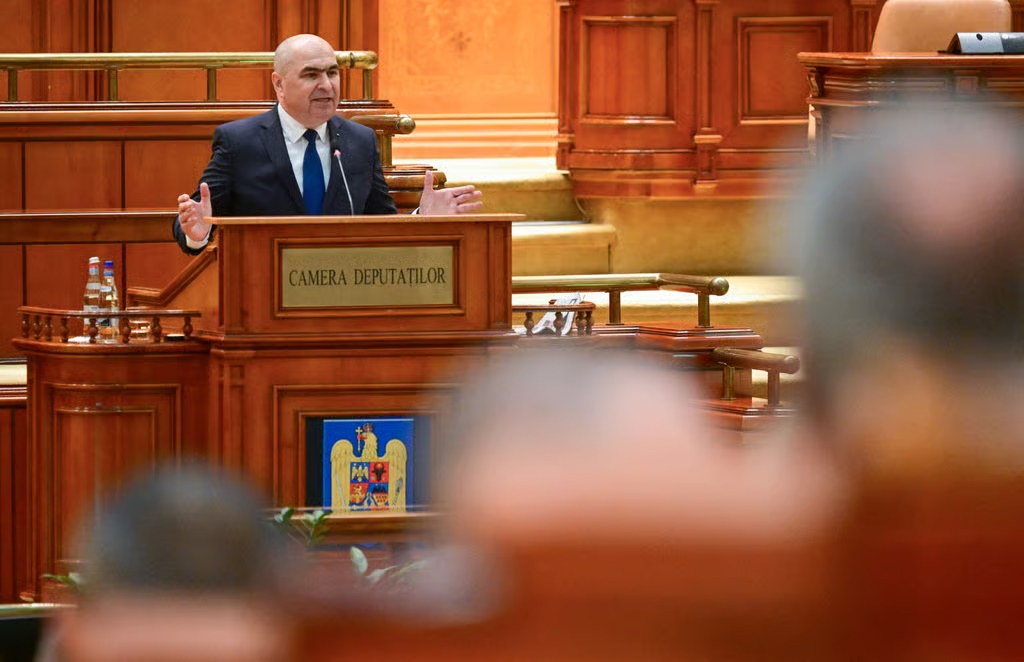
Center-right Prime Minister Ilie Bolojan, who heads the National Liberal Party, lost a confidence vote in the country’s parliament after only 10 months in office, bringing his short-lived and unpopular attempt to rein in the country’s budget deficit to an abrupt end.
The European Union’s sixth most populous country — and a key NATO member bordering Ukraine — now faces an uncertain future as it seeks to stave off the threat of an economic crisis in the months ahead.
Moderate centrist President Nicușor Dan is now expected to hold consultations with party leaders in an attempt to broker an agreement for a new coalition to take over running the country.
Bolojan’s defeat was in part masterminded by far right leader George Simion, who promised “an end to ten months during which the so-called pro-Europeans have delivered nothing but taxes, war and poverty.”
But Simion’s bid to oust the prime minister only succeeded because his far right Alliance for the Union of Romanians joined forces with the center-left Social Democratic Party (PSD), which quit Bolojan’s coalition government last month.
That unlikely alliance between the MAGA-supporting Simion and the Romanian social democrats triggered consternation among mainstream leaders in Brussels — who saw it as a new and unwelcome example of establishment parties teaming up with the populist far right.
Valérie Hayer, president of the liberal Renew group in the European Parliaement, called it “an irresponsible act at a critical moment,” while Ciarán Cuffe, co-chair of the European Green Party called it a “European warning sign.”
Critics of such tactical arrangements say any centrist party that works with the far right — even on a short-term basis — risks helping to normalize extremists who threaten the EU’s values.
Bolojan’s allies responded to their defeat by condemning the social democrats for partnering with Simion’s nationalists, who have threatened to cut aid to Ukraine and oppose EU migration policies.
“Creating parliamentary majorities with parties that are constantly attacking the EU and denying its role is profoundly anti-European,” said Siegfried Mureșan, a Romanian lawmaker in the European Parliament who is also vice-president of the center-right European People’s Party, to which Bolojan’s party belongs.
“I call upon the Party of European Socialists to explain why it is openly aligning itself with one of the most radically anti-European and extremist political forces in the EU,” Mureșan added.
A fresh crisis
For Romania, the government’s collapse heralds yet another episode in its recent history of upheaval.
A vast, suspected foreign interference operation forced the 2024 presidential election to be canceled, and the frontrunner in that contest now faces trial on coup charges.
Romania is also suffering from soaring inflation and has the EU’s highest budget deficit. If the country does not complete key reforms by August, it risks losing out on around €11 billion in EU funding, and if public finances aren’t brought under control soon, analysts worry a credit rating downgrade could follow soon afterward.
During his brief time in office, Bolojan attempted to tackle the challenges Romania faces with painful austerity plans he attempted to impose with headstrong determination.
But last month the social democrats, who hold the most seats in parliament, pulled out of the prime minister’s coalition government in a show of protests against his leadership and the spending cuts that affected parts of the country they represent. The PSD’s decision to work with Simion to overthrow Bolojan may have a lasting impact on how the crisis unfolds.
Simion won the most votes in the first round of last year’s presidential election before losing to Dan in the run-off vote. Since then, his nationalists have consolidated their support and are currently leading the polls. But President Dan has been clear he will not allow Simion’s party to be part of the next government.
“I want to assure Romanians that, whatever happens, Romania will continue to follow its Western path, the state will continue to function, and there is political agreement on the immediate fundamental goals,” he said before the parliamentary vote.
Cristian Pîrvulescu, of the National University of Political Studies and Public Administration in Bucharest, said Dan was undertaking an “extremely difficult” task as he attempts to restore stability.
“He becomes the conductor of a dysfunctional orchestra at the worst possible moment,” he said. “The political crisis has now formally become a governmental one, with constitutional risks still on the table if coalition-building fails.”
One option initially on the table was for the socialists to form a fresh coalition government with Bolojan’s National Liberal Party, under the leadership of a new prime minister. “All options are open,” PSD leader Sorin Grindeanu said, adding that he hoped a solution would be found quickly.
Political analyst Radu Magdin said that several members of Bolojan’s party were already “trying to reach out” to encourage lawmakers to “think about the renewal of a pro-European coalition.”
But following an afternoon meeting of the party’s leadership, Liberal lawmaker Robert Sighiartău rejected the possibility of forming a new government with the socialists.
If the impasse continues, Dan may be obliged to appoint a technocratic prime minister who is not a prominent figure in any of the country’s political parties. Such a leader could potentially command wider support and be able to reassure investors that Romania remains committed to reducing its deficit and staying on a pro-Western political path.
Original source: https://www.politico.eu/article/romania-government-collapses/