


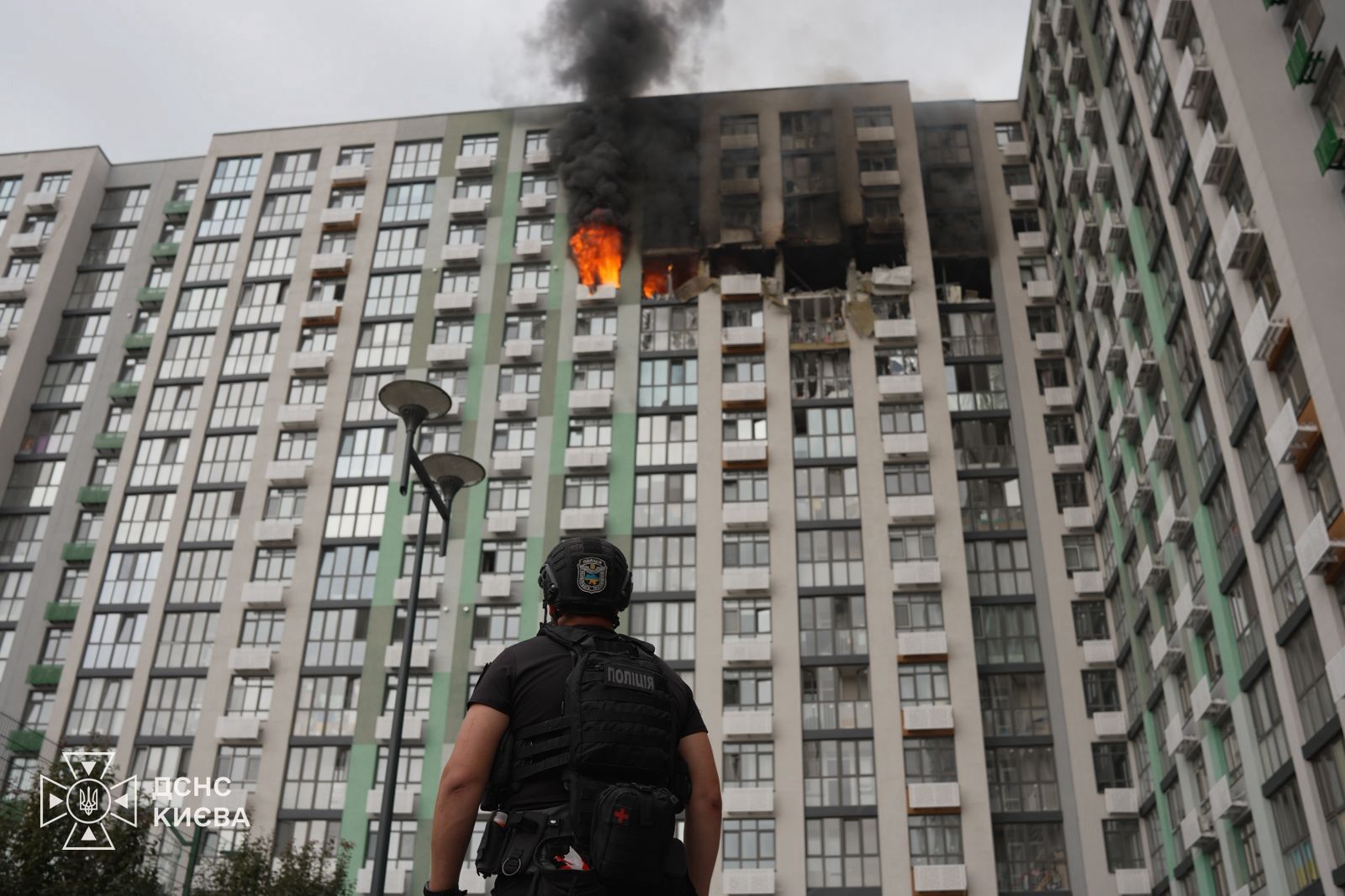
Kyiv and its surrounding region endured a sixth straight night of Russian drone and missile strikes on September 1, part of a sustained campaign that has left civilians, rail workers and rescue crews among the casualties across five fronts.
Russian forces launched a combined missile barrage in the early morning, including Zircon hypersonic missiles, Iskander-M and S-400 ballistic missiles, and North Korean KN-23 ballistic missiles.
The barrage was followed by nearly a full day of jet-powered UAV strikes.
The Kyiv City Military Administration said multiple districts were hit. The heaviest toll came at a railway depot, where Ukrzaliznytsia board chief Oleksandr Pertsovskyi said seven people died, six of them company employees. He described it as a ballistic strike aimed directly at the depot and other rail facilities.
According to a mid-morning update from Ukrainian Internal Affairs Minister Ivan Vyhivskyi, the death toll across Kyiv and the surrounding oblast stood at 12, with at least 20 injured, including children.
The figures continued to change throughout the day as rescue crews worked at the affected sites.
In Chernihiv Oblast, Russian strike UAVs hit the Kholmy community overnight, damaging educational facilities, private homes, a community center, and shops.
In a separate attack on the Novhorod-Siverskyi community, Russian forces struck a local enterprise, setting warehouses ablaze and damaging a private home and grocery store. No injuries or deaths were reported in either attack.
In Sumy Oblast, a drone strike on the Sumy community injured two men, ages 64 and 34, and left two women, ages 37 and 29, with acute stress reactions, according to the regional military administration.
Mortar shelling in the Seredyno-Buda community also wounded a 52-year-old woman.
On the eastern front, Ukrainian defenders stopped 45 attacks along the Pokrovsk direction, with fighting reported near more than a dozen settlements, including Bilytske, Serhiivka, and Dobropillia.
Russian forces also carried out 20 attacks along the Kostiantynivka direction.
A Russian FPV drone strike wounded four people in Kramatorsk, while a KAB glide bomb wounded five in Sloviansk.
Separately, a woman riding her bicycle in nearby Druzhkivka was killed in an FPV drone attack.
Kharkiv city and 15 settlements in the region came under shelling. A Russian drone strike on the village of Zolochiv damaged a minibus and left a 30-year-old woman and two children, ages 3 and 7, with acute stress reactions.
Russia has maintained a similarly punishing pace of attacks against multiple Ukrainian cities in recent weeks, a pattern documented in The Gateway Pundit.
Along the Lyman direction in Luhansk Oblast, Russian forces launched six attacks near four settlements.
The southern front saw some of the largest combined drone attacks of the war to date. In Zaporizhzhia, a Russian drone struck a volunteer vehicle evacuating residents from Novotroitske, injuring two people.
A separate drone hit a State Emergency Service vehicle responding to a fire in Kushuhum, wounding four rescuers. A third strike in the same area hit a civilian car, killing a 73-year-old man and a 47-year-old woman and injuring a 38-year-old resident.
In Kherson, Russian strikes using aircraft, artillery, and drones killed two civilian men, ages 43 and 59, and injured 14 people, including two young girls.
Officials in both regions said the September 1 barrage ranked among the most intense combined drone assaults the south has faced since the war began.
They said the attacks deliberately targeted evacuation crews, firefighters, and residents rather than military positions.
Ukraine’s General Staff reported that Russian personnel losses had risen by approximately 1,440 over the previous 24 hours.
Ukrainian losses for the day were not disclosed. Meanwhile, critical infrastructure enterprises in Sumy Oblast received more than 28 tons of energy equipment from Sweden to help protect the power grid.
President Volodymyr Zelensky used his evening address to warn that Russian airspace is becoming unsafe for civil aviation because of the war Moscow started.
He cautioned airlines that use key Russian airports and said Ukraine’s Foreign Ministry would notify international aviation bodies of the risk.
The warning came as Zelensky separately signaled growing concern over the Kremlin’s intentions, an issue explored further in this Gateway Pundit analysis of Vladimir Putin’s recent military and diplomatic posture.
Moscow has rejected U.S. ceasefire proposals and continued to warn NATO’s Baltic members against provoking further escalation involving Belarus. The Kremlin, meanwhile, dismissed Zelensky’s airspace warning as an act of state terrorism.
The increase in long-range strike capability behind Zelensky’s warning follows a broader pattern of Russian weapons development, including the jet-powered munitions detailed in a prior dispatch on Moscow’s growing use of the Banderol missile-drone.
Ad block users: Some site features may not work correctly while an ad blocker is enabled, because they break scripts and content this website depends on. If you can’t see comments below, for example, please disable your ad blocker.

