


John Thune Isn’t Protecting the SAVE Act. He’s Protecting the Senate Money Machine.
By Christine Bish | The Bish Report
A nearly quarter-billion-dollar political operation, a $46 million dark-money pipeline and a Senate leader unwilling to use every available tool to pass election-integrity legislation.
Campaign-finance figures are drawn from FEC filings and cited public reports. Donor amounts may span different reporting periods; see methodology and sources.
Republicans were handed control of the Senate to govern, not to explain why governing is procedurally inconvenient. Yet the SAVE America Act—legislation requiring proof of citizenship for federal voter registration and identification at the polls—remains stalled while Senate Majority Leader John Thune defends the rule that gives its opponents an effective 60-vote veto.
Thune says he supports the legislation. He moved the measure onto the Senate floor, voted with Republicans to begin its consideration and publicly criticized Democrats for opposing voter-identification requirements. But support measured only by speeches is not leadership. The real test is whether the majority leader is willing to use the authority, time and procedural leverage of his office to produce a result.
So far, Thune has refused to eliminate or modify the legislative filibuster. He has rejected demands to force a genuine talking filibuster and says the votes are not available for a rules change. That leaves the bill trapped behind the very institutional barrier he has spent years defending.
Follow the money surrounding Senate leadership
Thune’s most important financial constituency is not limited to Friends of John Thune, his personal campaign committee. The larger source of political power is the Senate Leadership Fund, the super PAC aligned with Republican Senate leadership and now publicly identified with Thune.
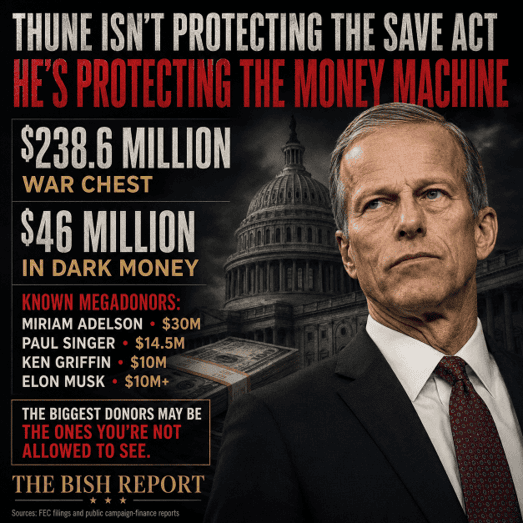
As of June 30, 2026, the Senate Leadership Fund had raised approximately $253.7 million for the cycle and reported about $238.6 million in cash on hand, according to campaign-finance reporting summarized by FactCheck.org. Its own fundraising announcement credited the work of Thune and the generosity of its “investors.”
That word matters. The organization is not describing ordinary voters casting ballots. It is describing the major financiers whose money allows Senate leadership to decide which candidates receive air cover, which races receive tens of millions of dollars and which Republican incumbents can depend on the establishment for survival.
The known megadonors
Public reporting based on Federal Election Commission filings identifies several billionaire donors among the fund’s most important financial supporters:
- Miriam Adelson — $30 million reported during the current cycle. Adelson is a casino billionaire and one of the Republican Party’s most consequential megadonors.
- Paul Singer — approximately $14.5 million reported during the current cycle. Singer founded Elliott Management and has long been a major financier of Republican political organizations.
- Ken Griffin — $10 million reported in 2026. Griffin, the founder of Citadel, has invested heavily in influencing Republican congressional races and the direction of the party.
- Elon Musk — at least $10 million across recent Senate Leadership Fund reporting periods, including additional contributions reported in late 2025. Musk’s giving also extends across other Republican and Trump-aligned organizations.
- Stephen Schwarzman — the Blackstone chief executive has been identified in current reporting as another major billionaire supporter of the Senate Leadership Fund and associated Senate candidates.
These donors are not evidence that any one individual ordered Thune to block the SAVE America Act. Campaign-finance records do not prove a private instruction or quid pro quo. They do, however, document the concentration of financial power surrounding Thune’s leadership operation—and the political system he has chosen to protect.
The $46 million the public cannot trace
The most troubling money is not attached to a famous name. It is the money whose original source cannot be seen.
The Senate Leadership Fund has received at least $46 million from One Nation, an affiliated organization operating under section 501(c)(4) of the tax code. One Nation is not required to publicly disclose the donors who supplied its funds. It can therefore collect money from undisclosed sources and transfer millions into a super PAC that spends openly in Senate elections.
The transfer itself is reported. The people, corporations or interests originally financing it may remain hidden. That distinction is the heart of the dark-money system: the public can see the final pipeline without being allowed to inspect everyone standing at its source.
One Nation is led by Steven Law, the longtime Republican operative who previously headed the Senate Leadership Fund. The organizations function as complementary parts of the same Senate political ecosystem: one can accept money without disclosing its original donors, while the other can spend enormous sums to shape elections.
Until those underlying donors are revealed, no one can honestly claim that the public has a complete list of the interests financing Thune’s Senate machine.
What Thune is protecting
Thune has defended the legislative filibuster since long before this particular fight. In 2021, he argued that the 60-vote requirement protects minority rights, forces compromise and preserves the Senate as a deliberative institution. When he became majority leader in 2025, he again promised to preserve it.
That history means his position cannot fairly be reduced to a newly invented excuse for the SAVE America Act. But it also makes his priorities unmistakable. When forced to choose between preserving the Senate’s institutional arrangements and passing the election legislation he claims to support, Thune has chosen the institution.
The filibuster also enhances leadership power. When ordinary legislation requires 60 votes, fewer major bills become law, negotiations move behind closed doors and leadership gains greater control over what reaches the floor. At the same time, every stalled priority becomes another fundraising message, another emergency appeal and another reason for wealthy donors to finance the next election.
That does not prove the filibuster exists for fundraising. It does show why permanent gridlock can be politically profitable. Failure is converted into campaign content; campaign content produces money; and that money strengthens the same leadership structure that failed to deliver the promised legislation.
Support without consequences is political theater
On March 17, the Senate voted 51–48 to take up the House message carrying the SAVE America Act. Thune made the motion to proceed. That record allows him to say he gave the bill floor time.
But the dispute is no longer about whether Thune uttered supportive words or scheduled a preliminary vote. The dispute is whether he is willing to impose consequences on the senators obstructing the bill.
A talking filibuster would require opponents to hold the floor and publicly sustain their obstruction. Keeping the Senate in session would force members to decide how long they are willing to block the measure. A rules change or targeted exception would confront the 60-vote barrier directly. Each option carries political and institutional costs—but leadership is the act of deciding which costs are worth paying.
Thune’s answer has been that the votes are not there. That may be an accurate count of his conference. It is not an explanation for why he will not force every senator to be recorded, exposed and held accountable for that position.
The questions Thune must answer
The financial record leads to two questions that cannot be dismissed as partisan rhetoric.
First: Who originally supplied the $46 million routed through One Nation? The public knows the name of the intermediary organization. It does not know the complete identity of the interests behind the money.
Second: Why is preserving the Senate’s current power structure more important than exhausting every lawful method of passing the SAVE America Act?
Republican voters did not create a Senate majority so its leader could preserve the minority party’s power to block the majority’s agenda. They expected results on election integrity, border security, spending and the other promises used to win their votes and contributions.
There is no public evidence that Miriam Adelson, Paul Singer, Ken Griffin, Elon Musk, Stephen Schwarzman or any other named donor personally directed Thune to stall this bill. Making that claim without evidence would weaken the legitimate case against him.
The documented case is already damning enough: Thune sits at the center of a Senate political operation holding nearly $239 million, supported by billionaires and at least $46 million in dark money. Faced with a choice between breaking the institutional logjam and preserving the system that empowers that operation, he has preserved the system.
John Thune is not protecting the SAVE America Act. He is protecting the Senate money machine. And the largest financial interests behind that machine may be the ones Americans are not allowed to see.
Sources
Federal Election Commission, Senate Leadership Fund committee profile and filings (Committee ID C00571703): https://www.fec.gov/data/committee/C00571703/
Federal Election Commission, John Thune candidate profile and Friends of John Thune filings: https://www.fec.gov/data/candidate/S2SD00068/
FactCheck.org, “Senate Leadership Fund,” August 7, 2026: https://www.factcheck.org/2026/08/senate-leadership-fund-5/
Senate Leadership Fund, “Thune’s Senate Super PAC Amasses $238 Million War Chest,” July 14, 2026: https://senateleadershipfund.org/press-releases/icymi-thunes-senate-super-pac-amasses-238-million-war-chest/
Sludge, “GOP’s Outside-Money Edge Is Being Built by Billionaires, Oil, and Crypto,” April 21, 2026: https://readsludge.com/2026/04/21/gops-outside-money-edge-is-being-built-by-billionaires-oil-and-crypto/
U.S. Senate Daily Press Gallery, proceedings for March 17, 2026: https://www.dailypress.senate.gov/tuesday-march-17-2026/
John Thune, “The Legislative Filibuster Must Remain,” January 26, 2021: https://www.thune.senate.gov/news/press-releases/thune-the-legislative-filibuster-must-remain/
Editor’s note: Contribution totals cited here are tied to the reporting periods identified by the underlying sources. Super PAC contributions are legally independent expenditures and are not direct contributions to Thune’s candidate committee.

