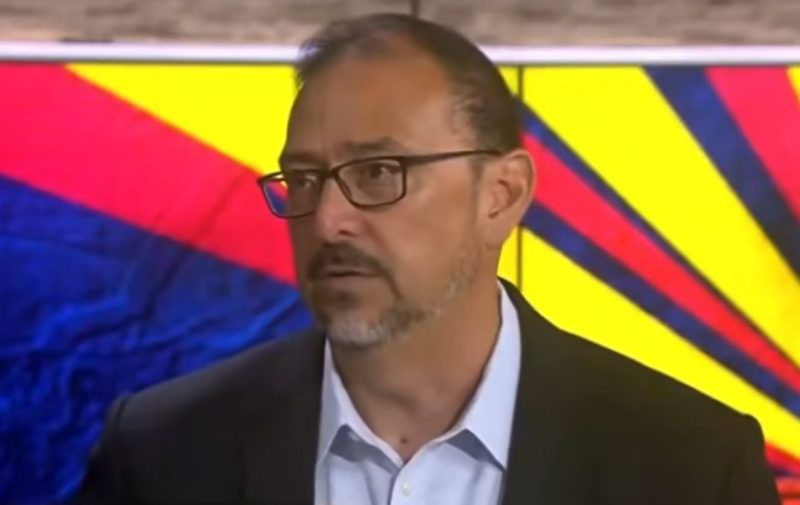
Arizona SOS Adrian Fontes Had Nearly Four Years to Show Arizona What Experience Looks Like in Office and He FAILED
THE INCUMBENT SOS FLUNKS THE TEST!
PART 2 – WHAT DOES IT TAKE TO BE SECRETARY OF STATE?
We established the test in Part 1…what makes a good Secretary of State includes knowledge of and experience in: Election law. Election Administration. Constitutional and Statutory Knowledge. Leadership. Management. Transparency…
And before we closed, we added some final qualifications: INTEGRITY, JUDGMENT AND ACCOUNTABILITY.
Part 1 ended with a simple question about the man who already holds the office: How Has He Performed? Now it is time to answer it.
Adrian Fontes technically does get the “Experience” point, as he’s been Arizona’s Secretary of State since January 2023, but … What Did He Do with It — Especially When His Authority, Management or Judgment Was Tested?
- Not theoretical experience. Not campaign experience. Not the experience of advising someone else who held the office.
Before that, he served as Maricopa County Recorder & Elections Chief. So, unlike a challenger, Fontes does not have to ask voters to “imagine” what he might do in office.
Experience Deserves Weight. It Does Not Deserve Immunity from Scrutiny.
So, let’s review that experience…
That does not mean every ordinary function of the office becomes an accomplishment:
- Completing an election on schedule is important — but it is also the job.
- Certifying results is important — but it is also the job.
- Administering the statewide election system, working with counties and carrying out statutory duties are not extra-credit assignments.
- They are the baseline.
The real question is what Fontes has done beyond the baseline — and what his record shows when things did not go as planned.
INTEGRITY, JUDGMENT AND ACCOUNTABILITY
A record is not measured only by successes. It is measured by what happens when a system fails, when a court says no, when information is mishandled, when authority is challenged — or when an officeholder is proved right.
That gives us a much more useful way to examine Adrian Fontes.
Not: HAS HE EVER MADE A MISTAKE? Of course he has…
But: WHAT DID HE DO WITH THE JOB WHEN THE TEST BECAME DIFFICULT?
THE CREDIT SIDE OF THE LEDGER
Fontes’s office has expanded voter-facing tools and election-security programs during his tenure. Such as: Arizona expanded BallotTrax statewide, allowing voters in all 15 counties to sign up for real-time ballot-status updates. The office also implemented Text2Cure to allow voters to address certain signature issues electronically.
His administration also established a dedicated election cybersecurity function, conducted cybersecurity and election-security exercises with counties and state and federal partners, and was recognized by the U.S. Election Assistance Commission with multiple national “Clearie” awards for election-administration programs.
One cybersecurity example is particularly concrete: after a vulnerability was identified in ConnectWise software, Arizona election-security partners were credited with helping counties detect and patch systems before they suffered compromises experienced elsewhere.
Those are real accomplishments. They belong on the record. So do the failures.
But A Report Card Does Not Stop at The A’s…
WHEN THE COURTS SAY YES — AND WHEN THEY SAY NO
Fontes has won important election-law fights. He has also lost some. And those two facts can exist at the same time.
In the major challenge over whether Arizona’s Elections Procedures Manual (EPM) must go through the Administrative Procedure Act’s formal rulemaking process, Fontes ultimately prevailed. The Arizona Supreme Court held that the EPM statute provides its own process and that the APA does not govern creation of the manual in the manner challengers had argued.
On that question, Fontes won. Voters lost.
But winning that structural fight did not mean every provision Fontes placed in an EPM was lawful. That victory answered only one question: how the EPM is created. It did not give the Secretary unlimited authority over what he could put inside it. In fact, on several specific provisions, courts drew boundaries — and Fontes crossed them.
Courts have separately restrained or struck provisions dealing with speech near polling places and particular election procedures after concluding that specific rules exceeded constitutional or statutory boundaries.
And This Question Did Not Begin When Fontes Became Secretary of State.
In 2020, while serving as Maricopa County Recorder, Fontes issued new instructions for mail ballots. The Arizona Supreme Court held that he “acted unlawfully,” concluding that the Recorder did not have constitutional or statutory authority to create those instructions.
Earlier that same year, during the COVID emergency, a Superior Court judge blocked Fontes’s plan to mail early ballots to registered Democrats who had not requested one for the Presidential Preference Election.
Different circumstances. Same underlying question:
Does An Election Official Understand Not Only What Power He Has — But Where That Power Stops?
WHAT HAPPENS AFTER “NO”?
We have three very different examples…
Example one: challenged EPM language.
When courts restrained certain language, later versions of the manual were revised or narrowed.
That belongs in the accountability column.
Example two: the protected-voter-data exposure.
This one is harder.
Fontes’s office accidentally released the addresses and telephone numbers of 373 protected voters. The error went undetected for nearly nine months.
When Fontes learned of it, he demanded accountability, affected voters were notified, efforts were made to retrieve the information, and a senior employee was terminated — although that employee disputed responsibility. Those are corrective actions.
But while affected voters were notified and corrective action was taken after the error was discovered, the broader public did not learn about the incident until much later through outside reporting. So, that raises a different accountability question:
CORRECTING A PROBLEM INTERNALLY IS NOT THE SAME THING AS EXPLAINING IT PUBLICLY.
EXAMPLE THREE: “THE BUCK STOPS WITH ME.”
Example three: the E-Qual candidate-petition system.
When the E-Qual candidate-petition system went down following an internal error, Fontes publicly accepted responsibility. He did not blame the programmer. He did not tell voters that somebody beneath him had made the mistake.
He said: “THE BUCK STOPS WITH ME.”
His office repaired the system. That is one example of public accountability. But accountability cannot depend on which mistake is being discussed.
SO WHY WAS THE PUBLIC RESPONSE TO THE PROTECTED VOTER-DATA FAILURE SO DIFFERENT?
Now Compare Examples Two and Three:
In both cases, something went wrong inside the Secretary of State’s Office.
In the protected-voter-data incident, corrective action was taken internally — but the public learned about the failure much later.
In the E-Qual failure, Fontes publicly accepted responsibility.
Same Secretary. Different problems. Different public responses.
That comparison — not the existence of the mistakes themselves — is the point.
What Does an Officeholder Do When Something Goes Wrong?
That is exactly the question our integrity, judgment and accountability test was designed to ask.
Fontes has now given Arizona nearly 4 years of evidence (8 including Recorder). Some of it strengthens his argument for another term. Some of it raises legitimate questions.
- He has relevant experience.
- He has overseen election-security innovations and voter-service programs.
- He has won significant court fights, and lost others.
- He has also had provisions of his election manuals restrained or struck.
- His office has corrected some mistakes.
- And at least once, he publicly said exactly what voters should expect from the person at the top:
THE BUCK STOPS WITH ME.
That may be the most important standard of all. Because an incumbent does not run only on what he promises to do next…
HE RUNS ON WHAT HE DID WHEN THE JOB WAS ALREADY HIS.
Fontes Has Taken the Test. Now Arizona Gets to Grade It…
PART 3 — The Challenger Alex Kolodin Takes the Test
PART 4 — The Final Report Card
By Linda Brickman
©2026 Linda Brickman. All Rights Reserved.