


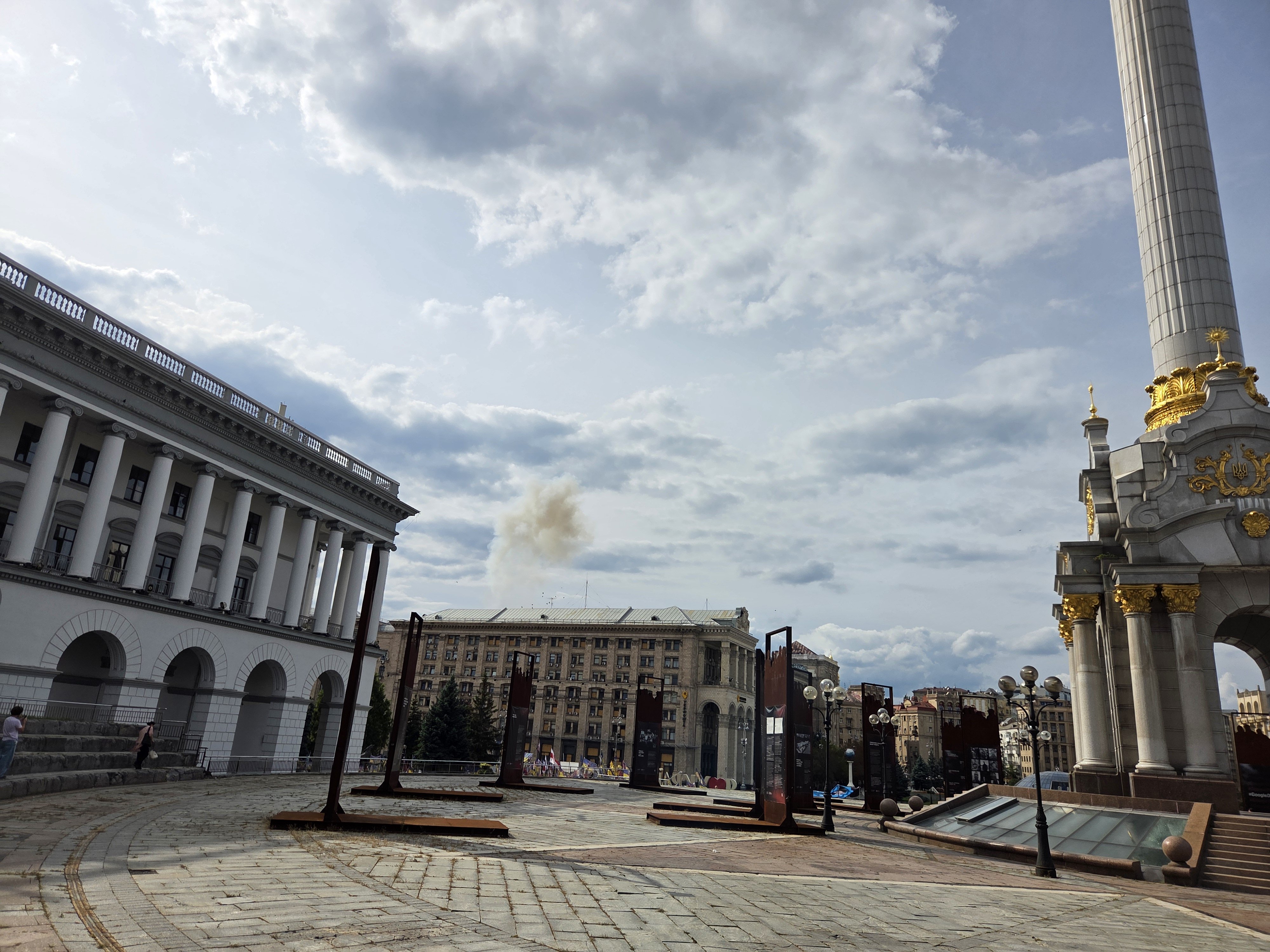
Living in Ukraine means being constantly subjected to missile and drone attacks, as well as the alerts, sirens, and warnings preceding them. The war ebbs and flows, with attacks becoming more or less frequent during different periods. As an observer on the ground, one never knows why, except that the pace of the war is determined by Putin. When he orders more attacks, there are more attacks.
Theoretically, when the siren goes off, you should seek shelter immediately. The sirens normally sound multiple times per day and several times during the night, but over the past week, the attacks have occurred several times per hour. Because it would be impossible to live any semblance of a normal life if you ran to the shelter each time, most citizens have learned to tune out the sirens and go about their day.
The explosions at night are the same. You get used to them, and sometimes you can sleep for eight hours, only to wake up and discover that buildings in another part of the city were destroyed.
A friend with young children told me that if he were alone, he would also ignore the alerts. However, because he has children, he is afraid to take the chance. He wakes them several times during the night and takes them to the shelter. Other families have begun sleeping in shelters every night as a standard practice. When I was still using a public shelter, I would find families there with their children fast asleep long before the alarm sounded.
Another adaptation is that civilians have learned the vocabulary and can identify the different types of drones and weapons being fired at them. They have learned to estimate the distance of an explosion by its sound and distinguish small-arms fire used against drones from the heavy machine guns used to protect bridges.
I witnessed a teacher at a Ukrainian school pause when she heard incoming, and the students instantly said, “It’s a missile, too big to be a drone.” A few moments later, a huge explosion could be heard, and everyone immediately pulled out their phones to check the feeds and see what had been hit and how many people had been killed or wounded.
On September 4, I was heading to the grocery store in the basement of the mall when the alarm went off. Attacks had been constant for the previous several days, and the alarm had become one more annoyance that people ignored. Looking around, I did not see a single person alter their steps or head for shelter.
I slowed my pace, knowing the grocery store would be locked when I arrived. Privately owned, one-off businesses can decide whether to remain open, but chain stores and some government facilities evacuate customers and lock their doors whenever the alarm sounds.
When I arrived, I found a group of Ukrainian teenagers waiting patiently to return to the mall. I sat apart, using my Ukrainian language-learning app while the teenagers chatted and did whatever teenagers do with their phones.
At that moment, I heard a jet engine overhead. In Burma, this usually means we are about to be bombed. It is not a sound I am used to hearing in Ukraine because there are no commercial flights, and neither military uses its air force widely. Normally, when you hear a drone close by, the explosion is seconds away. This one, however, was audible for so long that I knew there was no reason to take cover because it was going to pass us and hit somewhere else.
Two weeks earlier, our team was almost hit by a drone that we did not hear at all. It must have been launched from nearby. What struck me about this jet sound was how long it took for the weapon to hit. I glanced at the teenagers, who showed no emotion, but when they stuck their fingers in their ears, I did the same.
Seconds later, there was a massive explosion about 500 meters away, followed by a large cloud of smoke. By the time I removed my fingers from my ears and switched my phone from the language app to the camera, most of the smoke had dissipated, so my photos were less impressive than what had happened.
The smell was something I had not experienced during this war. The air was filled with the smell of cordite, which I had experienced only while briefly attached to a tank unit in the U.S. Army and working as a loader, where I was sprayed with the smoke and chemicals from each round fired. The cordite reminded me how much more destructive these munitions were than the 40 mm grenades and mortars dropped on us in Burma.
This particular weapon was a Banderol, a cross between a drone and a missile. It has a jet engine, an operational range of up to 500 kilometers, and a warhead weighing between 114 and 150 kilograms, including about 50 kilograms of explosives.
The 40 mm grenades and mortar shells we are used to seeing dropped from tactical quadcopters in Burma are micro-level tactical weapons. The S8000 Banderol is a stand-off operational cruise missile. Its payload is smaller than those of heavy cruise missiles such as the Kh-101 and Iskander-K, which carry roughly 400 to 500 kilograms, but larger than those of typical long-range strike drones. This places it in the hybrid “drone-missile” category.
Shortly after the concussion, which was extremely loud, the security guard keeping people out of the mall came over to ask the teenagers what had happened. They excitedly told him about the missile. During their conversation, the all-clear sounded, and I was able to buy milk, bread, and laundry soap.
On the way home, I grabbed something to eat at a restaurant underground to avoid being ushered out when the next attack came. I emerged and was about halfway home when the alarm went off again. The Russians continued the bombardment for the rest of the day and into the night.
Ad block users: Some site features may not work correctly while an ad blocker is enabled, because they break scripts and content this website depends on. If you can’t see comments below, for example, please disable your ad blocker.

