


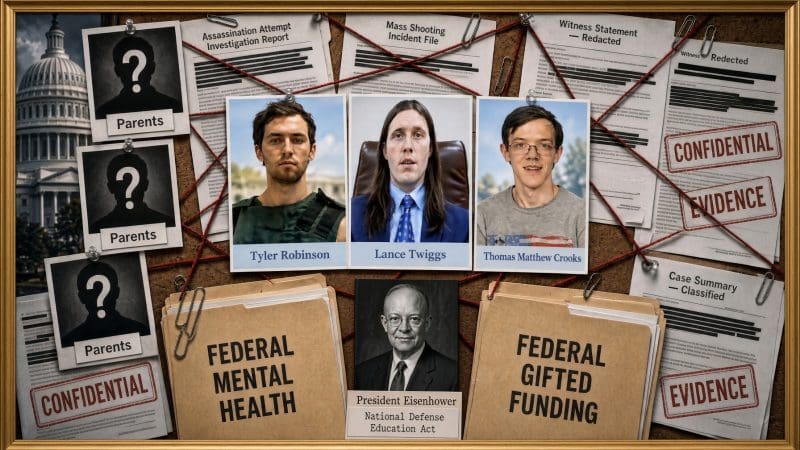
The Accused Assassins from Butler to Utah, and the Parents Who Escape Investigation
Republished with permission from AbleChild.
If the public is barred from learning about the parents of Lance Twiggs, Tyler Robinson, or Thomas Crooks, then the government must not be allowed to investigate or expose anyone’s family, no matter the crime or who is accused.
Foreign involvement has been the focus of respected independent reporters and podcasters, while mainstream media have largely ignored questions about the families of the accused assassin of Charlie Kirk and the accused would-be assassin of President Trump and killer of Corey Comperatore and James Copenhaver. Why not start closer to home, in the United States, with the families? The parents of both accused assassins have documented connections to the behavioral-health industry.
Reports describe Lance Twiggs as a straight-A student in an accelerated program and say his parents sent him money for expenses, including doctor visits and prescription drugs. The public deserves records establishing what support was provided, when, and what the family knew.
Concerning questions have come to light regarding public Utah records linking Scott Miles to Intermountain Support Coordination Services, LLC, where Amber Robinson also worked, and Utah Tech University where Lance Twiggs attended UT SUCCESS Academy, a gifted program. Utah officials should disclose when Robinson and Miles worked with the behavioral provider, Miles’s university role during Twiggs’ enrollment, whether Miles and Twiggs ever met, and what state officials knew. The timelines and influential relationships surrounding Twiggs are facts that can easily be confirmed by Governor Cox, afterall; he has total access to this information.
These same questions apply to both Thomas Crooks’s parents as well as Tyler Robinson’s parents whose professional backgrounds in behavioral health and recent financial issues have drawn attention. Did the parents supply to investigators education records, mental health records including all psychiatric drug “treatment,” and any participation in special government programs? A congressional task-force report said access to some FBI and ATF records was limited, including a recording of an interview with Crooks’s parents. Officials should identify what remains withheld and under what authority.
These cases raise questions not only about what families and officials knew, but also about the system that assesses, supports, and treats young people, and the public money behind it. That broader inquiry reaches back to the National Defense Education Act of 1958, passed to strengthen American education in response to national-security concerns.
Descriptions of President Eisenhower’s “able child” invites difficult questions: how have the ways we identify and support students changed, and how do those practices intersect with today’s behavioral-health funding and the horrible outcomes the country is experiencing? The public deserves the history, diagnostic criteria, and funding records. The behavioral health system where the parents reportedly worked is a billion-dollar industry with very little oversight that has been built on American tax dollars.
As support for gifted education declined and behavioral-health systems expanded, the country’s priorities appeared to change. Did the behavioral-health industry take characteristics once associated with the “able child,” repackage them as symptoms of mental illness, and redirect money appropriated for gifted education into mental-health programs? This diversion of funding would weaken our national defense and place children at the mercy of a dangerous mental-health system and groomers. The government should disclose grants, contracts, and program records for gifted education, ADHD diagnosis and treatment, and behavioral-health services. Investigate these connections.

What oversight applies when a young person who received services or “treatment” later commits suicide or becomes involved in a mass killing, or plans and carries out an assassination? Release the records. HIPAA is not a blanket shield. Its exceptions permit disclosure in defined circumstances, including certain disclosures to law enforcement to address a serious and imminent threat. If officials relied on those exceptions to investigate or obtain information about families, they must explain why relevant records remain unavailable to the public and identify the legal basis for every withholding.
The public should also be able to trace funding for psychiatric services and drug use, including services and drugs involving gender identity, which Twiggs was involved in according to Governor Cox.
AbleChild’s Georgia exhibit highlighted a stark funding disparity: the federal Javits Gifted and Talented program receives $16.5 million, while school ADHD-related services are estimated to cost $13.4 billion annually. The public should see the budgets and funding paths behind both figures.
Recent reporting has focused on Tyler Robinson’s family finances. The New York Post reported that Robinson’s father runs a masonry business and described a 2014 lawsuit in which his brother accused him of embezzling about $100,000, followed by a confidential settlement. The public deserves answers about financial support or payments connected to the parents in these cases: who provided money or other assistance, when, and why.
Amber Robinson, Tyler Robinson’s mother, reportedly worked for Intermountain Support Coordination Services, a Utah provider serving people with disabilities. What was her role, when did she work there, and what records document her professional connections and any relevant state contracts?
Newly released reports indicate Thomas Crooks’s father, Matthew Crooks, retired and is unemployed. When did Matthew retired and from where? The only verification is the State of PA recently showed Matthew didn’t renew license.
An anonymous donor reportedly paid for Crooks’s cremation. Who paid for the cremation, and why? The Crooks family also retained Pittsburgh law firm Quinn Logue. Who paid the firm’s fees, and what records disclose the arrangement? Officials should answer with records, not silence.
The FBI’s Behavioral Analysis Unit (BAU) analyzes criminal behavior and supports threat assessment. The FBI and other agencies should explain the methods, funding, and oversight behind behavioral threat assessment, and account for relevant connections between the adults involved and behavioral-health systems. Why has the BAU not exposed the relationship between these parents’ involvement in the billion-dollar behavioral-health industry and their children’s behavior? How does the BAU fail to solve mass killings, and assassinations? How have these parents escaped the hammer of the United States government?
AbleChild is a 501(3) C nonprofit organization that has recently co-written landmark legislation in Tennessee, setting a national precedent for transparency and accountability in the intersection of mental health, pharmaceutical practices, and public safety.
What you can do. Sign the Petition calling for federal hearings!
Donate! Every dollar you give is a powerful statement, a resounding declaration that the struggles of these families will no longer be ignored. Your generosity today will echo through generations, ensuring that the rights and well-being of children are fiercely guarded. Don’t let another family navigate this journey alone. Donate now and join us in creating a world where every child’s mind is nurtured, respected, and given the opportunity to thrive. As a 501(c)3 organization, your donation to AbleChild is not only an investment in the well-being of vulnerable children but also a tax-deductible contribution to a cause that transcends individual lives.

