


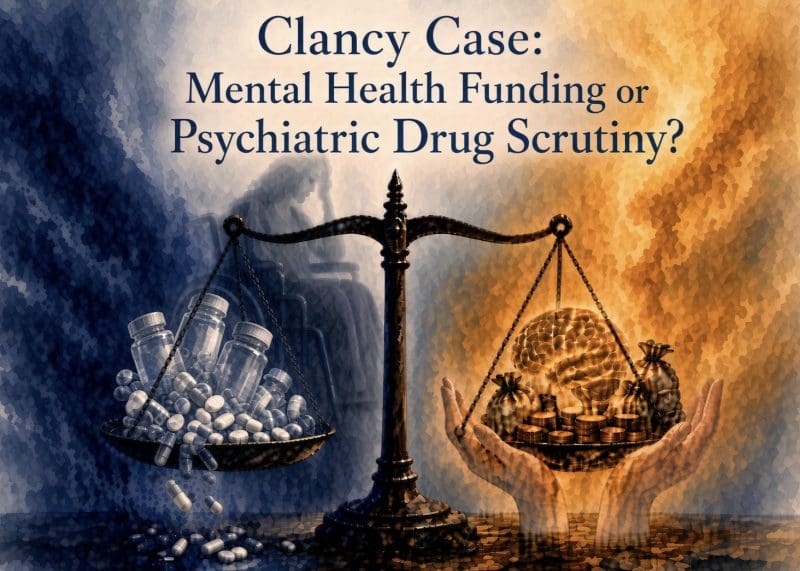
ABLECHILD: Lindsay Clancy Murder Case More Mental Health Funding or Scrutiny of Psychiatric Drugging?
Republished with permission from AbleChild.
The murder trial of Lindsay Clancy is about as high-profile as any murder case gets and with that comes the usual intense debate and discussion about whether postpartum mental health care needs to be expanded. On social media sites, the conversation about the Massachusetts mother’s culpability in the three children’s murders is, in a phrase, less than polite.
Advocates of psychiatric services argue that gaps in postpartum mental health care have been exposed and those advocates demand increased spending. Others argue that the psychiatric services provided to Clancy are responsible for the murderous behavior and the responsibility lies with the medical community for failing to consider Clancy’s physiological condition.
In the United States, where the modern mental health model is all about diagnosing and drugging, it makes sense that Clancy’s tele psychiatrist would prescribe a mind-altering antidepressant, Zoloft, before ever considering what is causing the symptoms. Recall that Clancy first advised the newbie psychiatrist that she was experiencing insomnia and felt a great deal of anxiety about returning to work as a labor and delivery nurse.
Ironically, it is common knowledge that Sertraline, also known as Zoloft, carries insomnia as a known side effect causing increased difficulty falling asleep or staying asleep, affecting about 20% of those who take the drug. Furthermore, none of the drug combinations (drug cocktails) prescribed to Clancy had been approved by the Food and Drug Administration (FDA) as “treatment” for insomnia, anxiety or depression.
Of course, advocates of increased spending on postpartum research believe that there is a need for more research into the symptoms of postpartum depression and making specialized care facilities available. On the other side of the issue, the argument rages against the medical community for failure to order basic blood tests to, at a minimum, rule out a physiological cause of the mental distress mothers are experiencing.
Currently, it is estimated that 85% of women experience some type of mood disturbance, with 10 to 15% developing more significant symptoms of depression and anxiety. Massachusetts General Hospital (MGH), for example, has a lengthy section on its website providing important information about the “categories” of postpartum symptoms, and it should be noted that MGH explains that the “postpartum period is characterized by a rapid shift in the hormonal environment.”
MGH goes on to explain that “while it appears that there is no consistent correlation between serum levels of estrogen, progesterone, cortisol, or thyroid hormones and the occurrence of postpartum mood disturbances, some investigators hypothesize that there is a subgroup of women who are particularly sensitive to the hormonal changes…”
The question, of course, is how does the medical establishment know which women are experiencing mental health issues who also may have hormonal and vitamin deficiencies that are common after giving birth, if blood tests are not conducted when these mood changes arise?
According to medical literature, blood tests to measure reproductive hormone levels are not routinely provided to new mothers and in the case of Lindsay Clancy, who was experiencing severe mental health symptoms, the tele psychiatrist did not order these basic blood tests before beginning poly psychiatric prescribing. In fact, the tele psychiatrist did not even conduct the Edinburgh Postnatal Depression Scale (EPDS) test until a month after first prescribing drugs to Clancy.
If increased funding is what advocates of psychiatric intervention are requesting, one must wonder what form that would take. Is this a request for increased research into the cause of postpartum depression? The fact is there is no abnormality in a woman’s brain that is postpartum depression, anxiety or insomnia that can be targeted for treatment with mind-altering drugs. Nor is there any regulation or policy that requires medicine to provide basic blood tests to postpartum women to rule out physiological deficiencies.
The federal government, through Medicaid, is the largest payer of mental health services, including covering 40% of U.S. births. In fact, most states provide full Medicaid services to pregnant women with 38 states offering postpartum services for a full year after birth. While the cost of postpartum benefits through Medicaid are sketchy, it is estimated that $4,200 per person is spent during months 3 through 12 and, over a 10-year period, the cost to taxpayers for postpartum Medicaid benefits is more than $1.2 billion. None of this federal funding requires basic blood tests prior to prescribing psychiatric drugs as treatment for postpartum mental health issues.
The argument for increased mental health spending is countered by those who say a return to basic medicine is the best way to address the deadly tragedy of Lindsay Clancy and other new mothers complaining of postpartum issues. One must ask why the medical community refuses to take seriously the role hormones and vitamin deficiencies play in the mood changes of new mothers.
After all, ordering blood work for new mothers complaining of mental health struggles is the least expensive option and the most effective in confirming or eliminating specific physiological diagnoses. And that data, the results of those blood tests, could be collected to establish whether there is a correlation between postpartum mental health issues and hormone and vitamin deficiencies, which would lead to a better understanding of what treatment best corrects the postpartum symptoms.
It also seems logical that, short of identifying an abnormality in the brain of women experiencing postpartum mental health struggles, psychiatry is left with the sole purpose of either providing talk therapy or what appears to be the go-to treatment of experimenting with mind-altering drugs on new mothers. And, frankly, one could make a convincing argument that the 32 prescriptions over a four-month period and the experimental drug cocktails did not, at any point, help the Massachusetts mother feel better or relieve the postpartum symptoms first reported.
At the end of the day, AbleChild has to ask, just how long the experimental drugging of Lindsay Clancy would have continued had she not experienced a psychotic break? And, more importantly, why are women seeking postpartum mental health assistance not being offered the least expensive, most revealing diagnostic medical tests, but instead are being labeled as mentally ill and plied with psychiatric mind-altering drugs? Now that’s research AbleChild would get behind.
AbleChild is a 501(3) C nonprofit organization that has recently co-written landmark legislation in Tennessee, setting a national precedent for transparency and accountability in the intersection of mental health, pharmaceutical practices, and public safety.
What you can do. Sign the Petition calling for federal hearings!
Donate! Every dollar you give is a powerful statement, a resounding declaration that the struggles of these families will no longer be ignored. Your generosity today will echo through generations, ensuring that the rights and well-being of children are fiercely guarded. Don’t let another family navigate this journey alone. Donate now and join us in creating a world where every child’s mind is nurtured, respected, and given the opportunity to thrive. As a 501(c)3 organization, your donation to AbleChild is not only an investment in the well-being of vulnerable children but also a tax-deductible contribution to a cause that transcends individual lives.

