Trump’s Saudi Nuclear Deal Risks Igniting a Middle East Arms Race, Lawmakers Warn
By FELICIA SCHWARTZ, JERRY WU and GISELLE RUHIYYIH EWING
The agreement, which could let Riyadh enrich its own uranium within a decade, is sparking warnings that Turkey, Egypt and others could soon demand the same deal, unraveling years of U.S. nonproliferation policy.
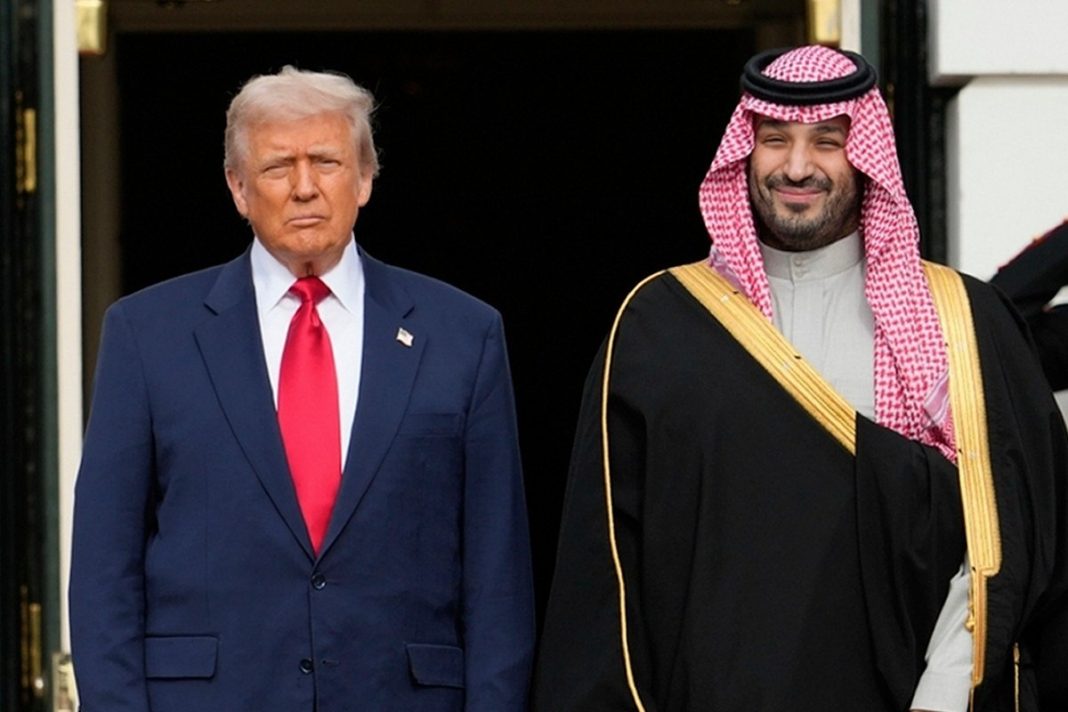
Some lawmakers in both parties are warning that the newly inked U.S. nuclear agreement deal with Saudi Arabia could ignite a Middle East arms race at a particularly dangerous moment — when the Iran war is already provoking conflict across the region.
While the deal is the culmination of a process that started before the war with Iran, announcing it now has an immediate effect on the fighting, argued Sen. Chris Murphy (D-Conn.), a member of the Senate Foreign Relations Committee who has been critical of Saudi Arabia.
“Everything that happens in Riyadh has a reaction in Tehran,” he said. “Part of the reason the United States has been reluctant to give this agreement to Saudi Arabia is because we knew it would end up pushing Iran closer to a nuclear weapon, and that remains true today.”
Even the potential of future nuclear enrichment by Saudi Arabia could swiftly shift the balance in the region and beyond, said Sen. John Kennedy (R-La.).
“I worry about nuclear proliferation in the Middle East, Japan, South Korea,” Kennedy said.
With the Trump administration already committed to the deal with Saudi Arabia, the power to reject it now shifts to Congress. But blocking the agreement would be an uphill fight, since lawmakers would need a veto-proof two-thirds majority in both chambers.
The 30-year agreement announced Wednesday allows private American nuclear companies to export to the Saudi market and creates a framework for American safeguards, though the administration did not release any details. While it does not guarantee Saudi Arabia would enrich uranium, and any such activities would likely be at least a decade away, lawmakers argued even this initial commitment could have ripple effects.
Sen. John Barrasso (R-Wyo.), a member of the Senate Foreign Relations Committee, expressed concern that it could further derail the U.S.’ push to get Iran to commit to zero enrichment of uranium.
“I’m very concerned about nuclear proliferation in the Middle East that potentially might have the effect of causing that,” he said.
The U.S. and Saudi Arabia have discussed an arrangement for nearly two decades in which the U.S. would help develop Riyadh’s civil nuclear program — a relationship that could provide billions to the American nuclear industry.
Both the Biden and the Trump administrations initially offered it as a sweetener to help convince Saudi Arabia to normalize ties with Israel, but the Trump administration decided to separate the two issues as it became clearer that normalization was more complicated in the aftermath of the Oct. 7, 2023, attacks on Israel, according to two people familiar with the matter, granted anonymity like others in this report to speak about sensitive diplomatic discussions.
Secretary of State Marco Rubio, asked about the deal while traveling in the Philippines Wednesday, rejected concerns that the arrangement would spark the spread of nuclear technology.
“The U.S. is not going to reach any agreement with any country in the world that leads to the risk of proliferation,” he said.
The White House referred to an announcement by the Energy Department.
“Rest assured, these agreements uphold the highest standards of nuclear safety and nonproliferation,” Energy Secretary Chris Wright said in the statement announcing the deal.
Saudi Arabia said in a statement the deal aims to bolster cooperation “in the peaceful uses of nuclear energy … in accordance with the highest international standards of nuclear safety, nuclear security, and non-proliferation.”
But countries in the region have previously expressed broader interests in the technology. Saudi Arabia’s de facto leader Crown Prince Mohammed bin Salman told CBS News’ Norah O’Donnell in 2018 that Riyadh would develop a nuclear weapon if Iran ever built one, raising the stakes of transferring such technology. Others in the region, such as Turkey, have also hinted they could pursue nuclear weapons should Tehran obtain one.
The U.S. has, for decades, avoided allowing new nuclear-cooperation partners to enrich domestically, insisting instead on the “gold standard” no-enrichment pledge, most notably with the United Arab Emirates in 2009.
Allowing Riyadh to do that could create a cascading proliferation risk, said Andrea Stricker, an expert on nuclear weapons proliferation at the Foundation for Defense of Democracies, a think tank that campaigned against the 2015 Iran nuclear deal.
“It could open a Pandora’s box of Russia and China providing these technologies to others simply because the United States did it first,” she said. ”We could also see other U.S. partners and allies such as Turkey, Egypt, the UAE, perhaps others like Qatar, Oman, lining up for similar treatment, and then soon you have many new states with the capability to enrich or reprocess plutonium, which leaves them a short distance from being able to make nuclear weapons.”
The alarm in Washington also centers on Saudi Arabia’s refusal to sign what is known as the “Additional Protocol,” an arrangement with the U.N.’s nuclear watchdog that would give inspectors broader access to catch covert nuclear activity, not just declared sites.
That and Saudi Arabia’s potential ability to enrich puts the deal well short of the so-called gold standard set by the 2009 UAE agreement, in which Abu Dhabi accepted such inspections and gave up the right to enrich uranium or reprocess plutonium at home. Critics say skipping both commitments abandons the template the U.S. has used for decades to curb nuclear proliferation.
The U.S. said Wednesday that it had reached a bilateral safeguards agreement with Saudi Arabia, without providing any details.
Sen. Ron Johnson (R-Wis.) said he was surprised that the administration reached a deal that could allow Riyadh to enrich, unlike past nuclear cooperation pacts.
“The thing that concerns me is about the potential for Iran to enrich or for Saudi Arabia to enrich. But I could envision that being totally under control, though, as well,” Johnson said.
Victoria Coates, who explored whether the U.S. could sell Riyadh nuclear technology as a senior official in the first Trump administration, said the deal poses a risk, “but one that can be mitigated.”
“As long as we stay very close to the situation and have visibility into it, I think it’s a risk worth taking,” said Coates, now at the conservative Heritage Foundation think tank.
Sen. Mike Rounds (R-S.D.) said he could be comfortable with allowing Saudi Arabia to enrich at home, depending on how the deal permits it.
“It depends on what they’re enriching it to. If it’s 60 percent or less, that’s way over what you need for [civilian purposes],” he said. “But if they’re talking about just enriching it to the point where you can use it for nuclear power plants, I don’t have a problem with that. Somebody needs to do that, and better be us than anybody else.”
Under the deal, the U.S. and Saudi Arabia would jointly study the feasibility of enriching uranium in the country. If they deem it acceptable, any enrichment would take place under a so-called black box arrangement that is meant to prevent the transfer of sensitive technology to Saudi Arabia, according to two people familiar with the deal. The Wall Street Journal first reported that the U.S. and Saudi Arabia had reached the agreement.
Saudi Arabia has long sought its own civil nuclear program. Some analysts say that it is better Riyadh cooperate with the U.S. rather than Moscow or Beijing.
“If the agreement hadn’t been made with the U.S., Riyadh almost certainly would have gone to China or Russia, which would have likely not included the restrictions the U.S. deal does,” said Jonathan Panikoff, a former career intelligence official now at the Atlantic Council. “But that doesn’t mean the risk is zero with this type of agreement.”
Original source: https://www.politico.com/news/2026/07/22/saudi-nuclear-pact-fears-regional-enrichment-01009142