

Supreme Court Blocks New Postal Service Rules for Mail Ballots in Blow to Trump
By Melissa Quinn, Jacob Rosen
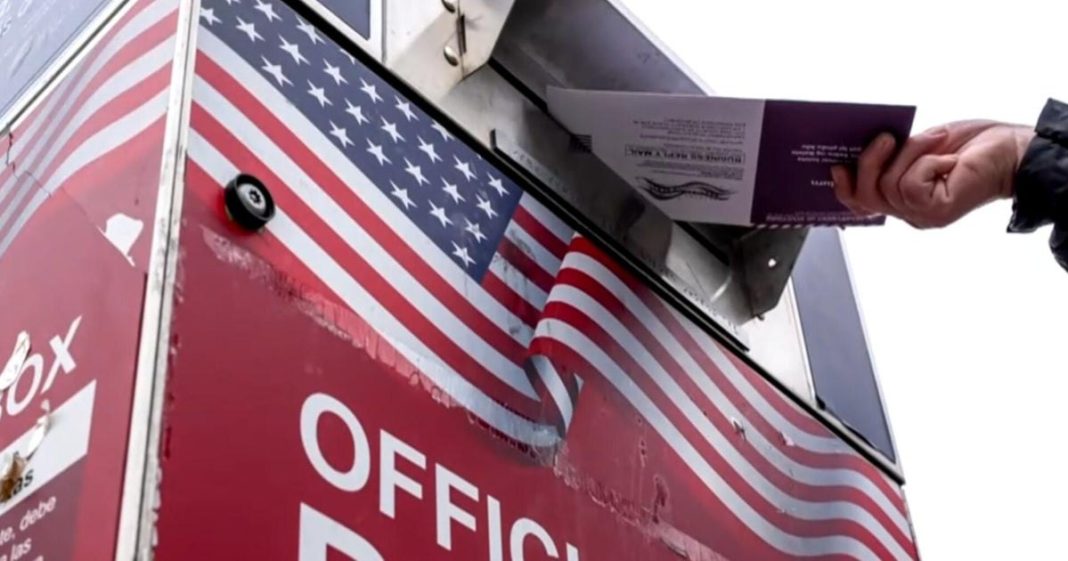
Washington — The Supreme Court on Monday left intact a lower court decision that blocked the U.S. Postal Service from enforcing new regulations for mail voting, rejecting the Trump administration’s effort to move forward with the rules in the run-up to the November midterm elections.
The court’s decision keeps implementation of the Postal Service’s requirements, finalized by the agency late last month, on hold while a legal challenge moves forward. Mail ballots have already gone out to voters in some states, and election officials at the state and local levels had warned it would be difficult for them to make the changes to comply with the new policies in time for the upcoming elections.
The Trump administration, meanwhile, had argued that the rules are needed to address the risk of fraud in mail voting, which Solicitor General D. John Sauer said is a “particularly pernicious species of fraud” that dilutes lawful votes and undermines public confidence in the integrity of elections.
But the administration has not come out with evidence of widespread voter fraud, and President Trump himself has voted by mail in Florida elections this year.
In a brief unsigned order, the Supreme Court said the government “is unlikely to succeed on the merits of its challenge to the District Court’s preliminary injunction.”
Two of the court’s conservative justices, Samuel Alito and Clarence Thomas, dissented from the court’s ruling, arguing the states that sued over the Postal Service’s new rules are unlikely to show the policy is unlawful.
A third conservative, Justice Brett Kavanaugh, sided with the majority. He wrote that “there is at least a fair prospect that the final rule falls within the Postal Service’s statutory authority.” But he found that applying the rule in the November midterms “would be arbitrary and capricious in violation of the Administrative Procedure Act because state and local election officials do not have sufficient time to reasonably implement the rule before the elections.”
Under the new rules from the Postal Service, mail ballot envelopes must meet certain design requirements, including unique barcodes, and state and local election officials must submit to an online portal certain information about voters who will receive mail ballots.
The Postal Service has said that any ballot mailings that don’t comply with its requirements will be rejected and returned to election offices.
The policies have raised alarm with election officials who are concerned significant numbers of voters could be disenfranchised and fear that if the policies take effect, they would upend states’ mail voting programs just ahead of the midterms.
Democratic-led states and voting rights groups that are challenging the new rules said they unconstitutionally infringe on states’ authority to administer elections. The Postal Service, they said, does not have the power to set rules for federal elections or mail voting.
In a filing last week, the states and voting rights groups argued that complying with the rule in time for the upcoming midterm elections would be “impossible” and said “millions of voters would be unable to vote by mail and some would not be able to vote at all.”
They added there would be “chaos” and said the new rules are “fraught with an extreme risk of error” that even if the states were to comply in time, “there is a high risk of technical breakdown, ineptitude, and delay,” by the Postal Service.
But the Trump administration has defended the regulations as “plainly constitutional” and said they impose only “modest” requirements for mail ballots.
“The Rule’s regulation of the U.S. Mail—not federal elections — is plainly constitutional,” Solicitor General D. John Sauer wrote in a filing to the Supreme Court. “While the States have primary authority to regulate the manner of elections, they cannot choose to use the federal mails to carry out their elections but then insist that their election-related mail is somehow exempt from the Postal Service’s rulemaking authority, conferred by Congress, to regulate envelope design and addressee information.”
The Supreme Court’s order caps a legal fight over Mr. Trump’s efforts to restrict mail voting that reached a fever pitch late last month. After the president signed an executive order in late March that called for the Postal Service to develop plans to regulate mail ballots and for the Department of Homeland Security to compile state-specific lists of residents who are U.S. citizens, a group of Democratic-led states filed a lawsuit challenging the directive.
Massachusetts-based U.S. District Judge Indira Talwani blocked the Trump administration from moving forward with key portions of the executive order, but the Supreme Court halted that decision on Aug. 24. In an unsigned 6-3 ruling, the high court said the states’ lawsuit was premature, in part because the Postal Service hadn’t finalized its plans.
The Postal Service published its final rule laying out its new mail voting regulations just days before the Supreme Court issued its earlier order. Soon after, two dozen Democratic-led states filed a new lawsuit seeking to block the policies.
Talwani issued a temporary order on Aug. 27 barring implementation of the rules for 14 days while she considered whether to issue a longer-term block. The Justice Department appealed that decision, but as the U.S. Court of Appeals for the 1st Circuit was weighing whether to halt that temporary order, the Trump administration went to the Supreme Court for relief.
Before the Supreme Court could rule on the emergency request to freeze Talwani’s order, the judge issued a preliminary injunction, which replaced her temporary order and blocked the Trump administration from requiring states to comply with the rule while the legal challenge continued.
The Trump administration then asked the Supreme Court for a third time to intervene in the case and withdrew its application for relief on the temporary order.
Separately, a judge in Washington, D.C., also blocked the mail-in ballot rules on Sunday, following a lawsuit brought by the Democratic National Committee and several other groups.
During a hearing earlier this month, Talwani said the Postal Service’s measure could lead to disenfranchisement, and she criticized the agency for failing to provide details about its plans. A senior Postal Service official said as of Sept. 3 that the agency was making “refinements” to the portal.
While the battle over the mail-voting plans was continuing in the courts, an anonymous whistleblower filed a disclosure with Congress warning of “potentially catastrophic problems” with the Postal Service’s portal and systems. The official said the platform is “untested” and “rushed,” and also warned that the new verification process for mail ballots could keep large numbers from being delivered to voters.
Attorney General Letitia James, one of the Democratic officials who sued over the mail-voting rules, praised the Supreme Court’s decision in a statement Monday.
“Today, the Supreme Court protected one of our most fundamental, inalienable rights — the right to make your voice heard at the ballot box,” she wrote. “This last-minute change could have thrown our elections into chaos, and I am truly relieved the Court granted this reprieve.”
Original Source: https://www.cbsnews.com/news/supreme-court-blocks-new-postal-service-mail-ballots-trump/

