Supermicro’s Cofounder was Just Arrested for Allegedly Smuggling $2.5 Billion in GPUs to China
By Amanda Gerut
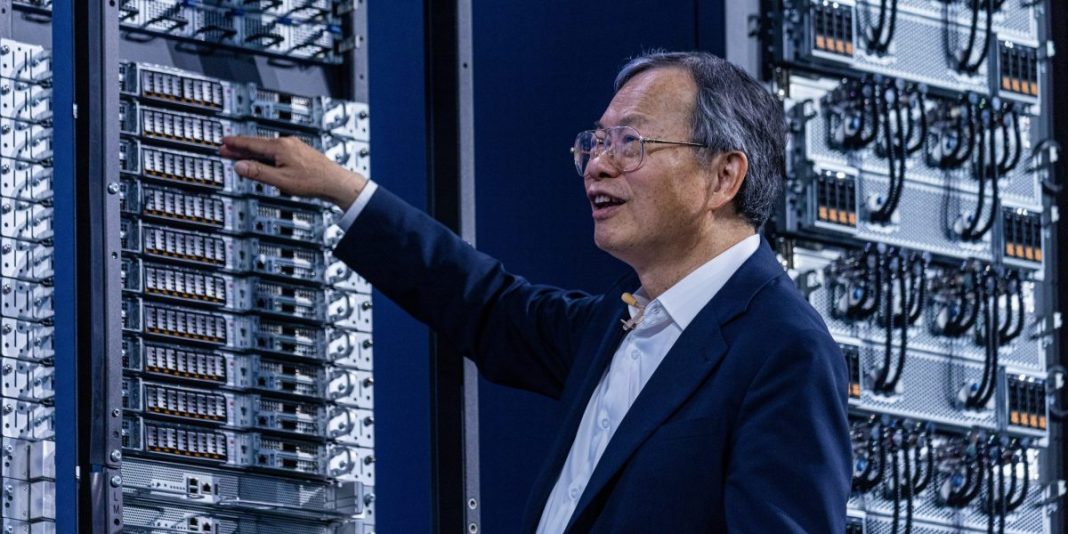
Federal agents on Thursday arrested Yih-Shyan “Wally” Liaw, a prominent Silicon Valley executive deep in the AI ecosystem who cofounded Supermicro in 1993 and is a close confidante of CEO and chairman Charles Liang. The stock tumbled roughly 12% in after-hours trading following the news.
According to a stunning release from the Department of Justice, an indictment was unsealed in Manhattan federal court on Thursday charging Liaw, 71, and two others with allegedly working in secret to divert billions in Supermicro AI servers to China in violation of U.S. export control laws. The two alleged co-conspirators charged alongside Liaw include Supermicro’s Taiwan general manager Ruei-Tsang “Steven” Chang, who remains a fugitive, and a third-party fixer named Ting-Wei “Willy” Sun, who was also taken into custody on Thursday.
The DOJ claims during 2024 and 2025, Liaw took a direct hand in the alleged conspiracy, working with Chang to allegedly find Chinese buyers who wanted the servers, which are packed with highly coveted Nvidia GPU chips, according to the indictment. The pipeline they allegedly constructed worked this way: Liaw and Chang would allegedly direct executives at an unnamed Southeast Asian company to place purchase orders with Supermicro as though they were destined for that company’s operations. The servers would then get assembled in the U.S., shipped to Supermicro’s facilities in Taiwan, and then delivered to the Southeast Asian company at a different location. From there, the Southeast Asian company, in tandem Liaw and Chang, would hand the servers off to a shipping and logistics company, which would allegedly get rid of the identifying packaging. They would allegedly put the servers in unmarked boxes before sending them to their true destination, which was China.
To keep the clandestine scheme from raising red flags with Supermicro’s compliance team, the defendants and the Southeast Asian company executives would fake documents and send false communications meant to show that the Southeast Asian company was the legitimate end buyer. During the two-year period, that company purchased about $2.5 billion worth of Supermicro servers under the alleged arrangement. The operation eventually grew even more “brazen,” authorities claim. The DOJ alleges that during a three-week period from late April to mid-May 2025, about half a billion worth of servers assembled in the U.S. were shipped to China as part of the alleged conspiracy.
To keep it under wraps, the defendants allegedly staged thousands of fake dummy servers—actual, physical replicas of Supermicro’s actual products, authorities claim—at the warehouse where the Southeast Asian company was supposed to be storing its purchases. In reality, the real servers were long gone and had allegedly been shipped to China already.
The DOJ claims surveillance cameras filmed Sun and an unnamed co-conspirator unboxing the fake servers, using a hair dryer to remove and reapply serial-number stickers and labels onto the dummy server boxes, then carefully repackaging them to pass inspection. The same phony servers were later used again to fool an audit conducted by the U.S. Department of Commerce, the DOJ alleges. Throughout the scheme, the defendants allegedly used encrypted messaging apps to discuss server quantities, delivery locations in China, and ways of keeping the operation hidden from Supermicro’s compliance team and U.S. authorities.
The DOJ says the Nvidia chips in the Supermicro servers were the target for the buyers. Liang has often touted his close business ties to Nvidia and its CEO Jensen Huang.
An Nvidia spokesperson said compliance is a “top priority” for the $4 trillion chipmaker.
“We continue to work closely with our customers and the government on compliance programs as export regulations have expanded. Unlawful diversion of controlled U.S. computers to China is a losing proposition across the board—Nvidia does not provide any service or support for such systems, and the enforcement mechanisms are rigorous and effective.”
In a statement, Supermicro said it is not a defendant in the indictment and that Liaw, who serves as a board member and as senior vice president of business development, has been placed on administrative leave. Chang has also been placed on leave, and Sun, who is at large, was fired from his contracting role. Supermicro said it is cooperating with the government investigation.
“The conduct by these individuals alleged in the indictment is a contravention of the Company’s policies and compliance controls, including efforts to circumvent applicable export control laws and regulations,” the statement says. “Supermicro maintains a robust compliance program and is committed to full adherence to all applicable U.S. export and re-export control laws and regulations.”
Authorities claim the scheme was all engineered to make money from Chinese buyers and thwart the export controls.
“The indictment unsealed today details alleged efforts to evade U.S. export laws through false documents, staged dummy servers to mislead inspectors, and convoluted transshipment schemes, in order to obfuscate the true destination of restricted AI technology—China,” said John A. Eisenberg, Assistant Attorney General for National Security.
The stream of compliance and governance issues leading up to Liaw’s stunning arrest all point to mounting problems with controls at the hardware manufacturer.
The Backstory
Trading in Supermicro’s stock was suspended in 2018, after the company fell out of compliance with Nasdaq listing standards while the Securities & Exchange Commission conducted an investigation into its accounting practices. That same year, Liaw resigned all his positions with the company following a related internal audit committee investigation. In 2020, the company was ordered to pay a $17.5 million penalty and its chief financial officer resigned. Liaw returned to the fold in May 2021 as an adviser to Supermicro in “business development.” He returned to a full-time senior executive post in August 2022 and in December 2023, he rejoined the board.
Supermicro again faced the heat in August 2024 when short-seller Hindenburg took a position in the stock and published a scathing report on the company, alleging that the accounting issues had returned. Supermicro denied Hindenburg’s allegations.
However, around the same time, Supermicro’s auditor Ernst & Young sent a letter to the board’s audit committee flagging concerns about governance, transparency, and raising questions about whether the annual report could be filed on time. The board responded by appointing a special committee and bringing in Cooley LLP and forensic accounting firm Secretariat Advisors to investigate—again.
Then in October 2024, in the middle of an audit, EY abruptly resigned and its language pulled no punches. EY said it could “no longer rely on management’s and the Audit Committee’s representations” and was “unwilling to be associated with the financial statements prepared by management.”
The resignation set off a chain reaction. Without an auditor, Supermicro couldn’t file its annual report for fiscal 2024 or its quarterly reports. Nasdaq gave the company a grace period until November, but it was at risk of a second trading suspension in six years.
Days before the November deadline, Supermicro announced that it had hired BDO USA as its replacement auditor and submitted a compliance plan to Nasdaq that put it in better standing with the exchange.
In December 2024, the special committee that investigated EY’s allegations—made up of a single board member—concluded there was no evidence of fraud or misconduct and said EY’s decision to resign was “not supported by facts.” Liang declared the company was out of the woods and CFO David Weigand called the investigation a “distraction.”
However, the committee’s report found lapses that it blamed on Weigand and recommended replacing him. Supermicro pledged to implement the committee’s recommendations “immediately.” That was 15 months ago. Weigand remains the CFO of Supermicro.
Liaw could not be reached for comment.
Original source: https://fortune.com/2026/03/19/supermicro-arrested-founder-smuggling-gpu-china/