


Born from the lessons of Ukraine, Rassvet promises secure battlefield communications, Arctic coverage, and independence from foreign technology
On the night of August 15, 2026, the industrial outskirts of Samara lit up as Ukrainian long-range Flamingo missiles targeted factory buildings. By morning, news appeared online of a plume of smoke, and a few days later, satellite imagery revealed a large crater at the site of one of the buildings of the Progress Rocket and Space Center.
The fact that the war reaches thousands of kilometers beyond the front line no longer surprises anyone. However, the target is rather unexpected: It’s not an ammunition depot, oil refinery, or power substation, but a factory where launch vehicles are manufactured.
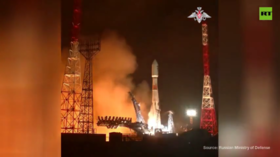
In the spring and summer of 2026, two Soyuz-2.1b rockets were launched from Plesetsk Cosmodrome, each carrying 16 satellites into orbit. These satellites are called Rassvet (Dawn). Soyuz rockets used to launch the satellites are assembled in Samara.
Why did Ukraine strike this facility? Because it possesses no anti-satellite capabilities of its own – a fact that Kiev openly acknowledges, stating that only four nations (the US, China, India, and Russia) have these missiles. The only option left is to strike the ground, targeting the facilities essential for launching the satellites. After all, a satellite that never makes it into space is no different from a satellite that has been shot down.
Western and Ukrainian media focus exclusively on the issues of Rassvet satellites, citing problems with altitude, ascent, and launch schedule. Yet, no one attacks a failed project. The adversary’s assessment of the project and its importance speaks for itself.
Both critics and supporters of the satellite constellation refer to it as the Russian Starlink. Military expert Andrey Bednarsky, a drone operations officer with the Kaskad specialized brigade and a UAV developer, acknowledges an “element of journalistic generalization” in this comparison but does not consider it unfair.
“Starlink was the technological leader in this niche, so a comparison with the industry pioneer is justified. But though justified, it’s misleading. Such a label implies a copy that is supposed to catch up with the original, following a pre-established path. Yet what we see is a different answer to the same question, posed by the war.
“The question goes something like this: what happens to an army and a country when broadband connectivity ceases to be merely a service and becomes critical infrastructure, on par with electricity or railway networks? Elon Musk’s answer has been familiar to us for four years now – the captured [Starlink] technology is stacked in crates at Russian command posts. Russia’s answer is being formulated right now,” he says.
There is currently a gap between the present and future capabilities of Russian technology, Bednarsky notes. Presently, there are about 30 Rassvet satellites in orbit; there is also an ongoing debate over altitude, and only three or four communication windows per day in the combat zone. However, by 2030, Russia expects 292 satellites in orbit and continuous coverage. It is precisely this gap that draws the researcher’s attention.
The Volnovakha lesson
In the spring of 2022, Russian units captured several Ukrainian command posts near Volnovakha. Military analyst Alexei Leonkov says that in the early months of the military operation, Starlink routers, along with other equipment, were found in the seized command facilities. Lying nearby were tablets running battle management software.

“The picture became clear very quickly. The entire communication system of the Ukrainian army and its link to NATO headquarters relied on a single commercial satellite constellation – not a state-owned one, and not military in origin. It belonged to a private American entrepreneur who, by that point, had effectively become a participant in the war without formally being a party to it,” Leonkov says.
This was no secret in itself. Russia knew about the supply of Starlink terminals to Kiev in the very first weeks of the conflict. But reading the news is one thing; holding the hardware in your hands and realizing that everything goes through it – reports, target designation, coordination with external command centers – is quite another.
Leonkov articulates the conclusion made by many experts at the time. “Issues of combat command and control, the speed of information transmission, and coordination within the information space provide an advantage in both offensive and defensive operations. Communication is no longer just about rear-echelon support; it has become a weapon,” he says.
This logic continued to unfold in the coming years. Starting in 2023, drones penetrated beyond the front line and operated far outside the combat zone; their operational range and strike coordination also relied on Starlink. Leonkov analyzes the recent series of attacks, which Ukrainian leader Vladimir Zelensky dubbed the 40-day war, as a distinct technological episode. It was conducted not only via the civilian constellation of satellites and its military-focused division, Starshield, but also, according to Leonkov, by means of AI utilizing high-speed data networks to coordinate tactical maneuvers. This allowed the drones to maneuver, form groups and swarms, as well as suppress and penetrate Russian air defense systems.
A drone swarm that reconfigures in flight requires a data link. A link requires an orbit. An orbit requires rockets, a factory, and funding.
This is precisely what may be called technological sovereignty: possessing one’s own satellite constellation to ensure stable connectivity across the entire country and beyond.
What is Rassvet?
The company Bureau 1440 was founded in 2020 within the ICS Holding group of technology companies. Today, it employs approximately 3,500 people; around 80% of them are engineers, designers, and software developers specializing in spacecraft control systems. This structure is atypical for the Russian space industry. Rather than a design bureau with a half-century-long history, it is a company established to tackle a particular task.
The project is funded under the Data Economy national initiative, with 102.8 billion rubles (about $1.2 billion) from the federal budget and 329 billion from the company’s own funds through 2030. This ratio clearly reveals that the business sector bears the bulk of the costs, while the state provides supplementary funding and sets the strategic direction.
In 2023, the first three experimental satellites (the Rassvet-1 mission) were launched into orbit. They were followed by three more satellites (Rassvet-2) used to test sequential data transmission between satellites at distances ranging from 30 km to 1,000 km. Then came a pause (explained in the industry in various ways), followed by the transition to mass production.
On March 23, 2026, a Soyuz-2.1b rocket equipped with a Fregat-M upper stage launched 16 satellites from the Plesetsk Cosmodrome to an altitude of approximately 300 km. After separation, the constellation was taken under the control of Bureau 1440’s own Mission Control Center. The company emphasized that the journey from the initial experimental satellites to the mass-produced models took 1,000 days.
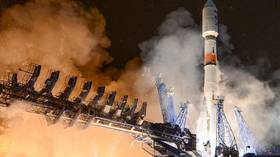
A second batch was launched on July 19-20. The company did not disclose the launch site, and the surrounding landscape was not visible on the widely circulated photo of the Soyuz-2.1b on the launch pad. This small yet important detail shows that a project that began as a civilian internet initiative had, by mid-2026, turned into a defense initiative.
We should take a closer look at the figures. Prior to the July launch, the company reported having 18 satellites in orbit, three of which were experimental; this implies that one satellite from the initial batch was lost. Following the second launch, there were around 30 operational satellites in orbit. The target constellation size is 292 satellites by 2030, including spares. To compare, Starlink already has thousands of satellites in orbit.

This explains the caution exercised by experts when making comparisons. This is justified, given that Starlink was the first to occupy the niche and set the industry standard. Yet, another observation is far more interesting: Rassvet is not blindly imitating the industry leader, but is trying to overcome Starlink’s limitations and chart its own course. This claim can be tested when it comes to the debate over altitude.
The debate over altitude
The target orbit for Rassvet is 800 km. The satellites are initially deployed to an intermediate altitude of 300 km and subsequently ascend using their own plasma thrusters. This is the standard operational procedure for low-Earth orbit constellations.
The key issue lies in the rate of ascent of the satellites. ComNews, having analyzed data from NORAD and public tracking services, noted that during the first four months, the satellites from the first batch rose from 300 km to 540 km, an average rate of around 2 km per day. However, the rate of ascent subsequently slowed; from June 10 to July 20, the total gain was merely 50-90 km. At the current rate, it would take another four and a half to six months to reach the announced 800 km altitude, meaning it would take at least until November to reach the target orbit. This led to an opinion expressed in the headline: that the target altitude had likely been lowered.
As of August 3, data on individual satellites presents a mixed picture. Most satellites from the first batch maintained altitudes of 518-541 km. Three lagged significantly behind, at 370, 376, and 414 km. One burned up in the atmosphere on June 6.
The Western press seized on these figures and attempted to draw conclusions. Citing Business Insider, reports claimed that none of the satellites from the July launch had reached their operational orbit and that, without intervention, they risked eventually burning up. However, the words used by the original authors to highlight uncertainty were lost in subsequent versions.
Bednarsky points out two important details.
The first one is procedural.
“Regarding the second batch of satellites,” the expert says, “our enemies and competitors are hyping a story that they failed to reach their anticipated altitudes. But we simply don’t know what the anticipated altitude is; the company hasn’t confirmed it. We’ll be able to tell whether the constellation has reached its intended operational altitude only in October or November, not earlier.”
The second detail is far more interesting. The 300-500 km altitude where the satellites are currently located roughly corresponds to the operational altitude of the standard Starlink system. “If the altitude is deliberately lowered, there is a clear physical reason for the decision: the lower the satellite, the higher the signal at the surface and the lower the response latency. At the same time, of course, the coverage area decreases; from an altitude of 700-800 kilometers, a single satellite covers a much larger territory,” he explains.
Bednarsky also points to another factor. The choice of responsiveness over broad coverage, he suggests, “may be linked to the objectives of the Russia’s military operation – specifically, controlling drones and uncrewed surface vessels.” Neither tolerates extra milliseconds of latency. Speed is a key parameter of modern warfare.

This is most likely a temporary technical decision dictated by the fact that Russia currently possesses a limited number of satellites. A small constellation cannot provide country-wide coverage from a high orbit, but it can establish a functional low-orbit tier over the active combat zone.
This is an attempt to chart one’s own path: prioritizing coverage of the front line rather than building a global network first. The debate over altitude is, therefore, a debate over priorities. And there is no doubt that the successful conclusion of the military operation is one of Russia’s key strategic priorities.
Three communication windows per day
What does Rassvet offer military users on the front line right now?
Rassvet satellites enable stable satellite connectivity over the Special Military Operation zone, providing several (3-4) communication windows per day for a duration of several hours. While this is a genuine breakthrough compared to how things were before, it is insufficient for carrying out daily combat missions, and an expansion of the satellite constellation is necessary.
A communication window is not the same as a continuous, stable communication channel. A unit that has connectivity for a few hours three times a day plans its actions differently than a unit with constant access. The difference between a device that merely works and one that is a game-changer is measured not by signal quality, but by the number of satellites in orbit.
Leonkov views the situation from the angle of combat command and control. “The deployment of a constellation utilizing modern data transmission formats offers a natural solution to three tasks: developing civilian communications, coordinating army operations in the combat zone, and securing state borders.” According to him, the first batch of satellites has already begun performing these tasks.
He also says that the Svod AI system was integrated into the satellite constellation, enabling troops to receive real-time air and aerospace data both in the combat zone and outside it. The Russian Defense Ministry commented on this system in January 2026, saying that it is not a standalone device but a software architecture running on a network of military computers and tablets. It aggregates satellite data, aerial imagery, intelligence reports, and open-source information into a unified information space, models scenarios, and proposes courses of action to the commander.

As Leonkov noted, “the combination of the satellite constellation and AI has increased the effectiveness of air defense operations several-fold.”
“Those who switched from captured Starlink routers to domestic systems gained an advantage in data transmission security amid intense electronic warfare,” he said.
Let’s stop here for a moment: The value of the constellation is measured not in megabits, but in its ability to close the communications loop. The satellite provides the channel, and the channel provides a general picture, which, in turn, enables rapid decision-making. The three operational windows per day are the first proof that the system works.
Laser instead of a gateway station
The primary advantage of the Rassvet system is not speed or orbital altitude; it’s inter-satellite laser communication. According to Bednarsky, it reaches up to ten gigabits per second. This means we’re dealing with cutting-edge technology, possibly the best in the world. This capability was tested on the experimental Rassvet-2 when data was transmitted between satellites over distances ranging from 30 to 1,000 km.
The rationale behind laser technology is simple. It significantly reduces reliance on ground-based gateway stations. A satellite lacking inter-satellite links acts merely as a relay. It receives a signal from a user and transmits it to the nearest ground station; if no station is within sight, there is no connection.
Russia has eleven time zones, touches several oceans, extends into the Arctic, and possesses remote territories where installing a gateway station is not feasible, so this limitation is a deal-breaker. It is even more critical for a country that cannot rely on friendly ground stations abroad. However, a laser link transforms the constellation into a network: data travels in orbit from satellite to satellite and is downlinked wherever it is convenient and secure.
On the user end, the picture is more modest. The stated target speed per terminal is up to one gigabit per second. However, actual test measurements reported by RBC are far more prosaic: 12 megabits per second per device with a latency of 41 milliseconds. So the first figure represents the long-term goal, while the second reflects the current situation, given that the constellation is not complete. Comparing the two figures is inappropriate, but we must keep both in mind.
Not much public information is available about the user terminal, and journalists have no access to it. From what we know, the unit weighs 14-15 kg. For comparison, a standard consumer Starlink dish weighs just a few kilograms and can be carried with one hand.
This leads to an obvious conclusion regarding the market. For individuals, this equipment would be rather inconvenient. However, it is suitable for mobile platforms – cars, ships, trains, and aircraft.
Let’s take a look at some of Bureau 1440’s first civilian contracts.
Lastochka, Sapsan, and northern latitudes
At the CIPR 2026 conference, Bureau 1440 and Russian Railways (RZD) agreed on the phased rollout of next-generation satellite connectivity for high-speed trains. The agreement covers 135 Lastochka and Sapsan high-speed trains across the country, serving routes such as Moscow-St. Petersburg, Moscow-Nizhny Novgorod, Krasnodar-Sochi, and Moscow-Minsk. The user terminal designed for rail transport has already undergone mechanical testing on a test railcar; Alexey Shelobkov, head of ICS Holding, announced the start of these tests.
The choice of Russian Railways as the first civilian customer is quite logical. A train travels hundreds of kilometers through terrain where there is no stable cellular signal. Meanwhile, there is ample space on the train carriage roof for a 15-kilogram terminal, and the passengers are highly interested in having a stable internet connection.
In parallel, pilot projects have been announced for 2026 in several regions, including the Nenets Autonomous Okrug. In April, Roscosmos Deputy Director General for Strategic Development Boris Glazkov, stated that Rassvet satellite internet service would become available to corporate clients in 2027-2028. Georgy Korolev, a project director at ATK Consulting, is even more optimistic. He says that limited testing of signal quality, speed, and coverage is already underway with select users, and believes the first commercial contracts could be signed by late 2026 or early 2027.
The list of use cases outlined by the company offers solutions to many of Russia’s challenges, such as remote regions, northern territories, maritime operations, transport, oil extraction, the energy sector, communications in disaster zones, the remote monitoring of facilities and specialized vehicles, and video analytics. All this is particularly important for those parts of the country where laying fiber-optic cables is impossible.

This brings us to a detail that Bednarsky identifies as a key technical feature of the project: the orbital inclination of Rassvet is approximately 82 degrees. Such an inclination is typical for systems designed to operate at high latitudes. The expert’s conclusion is straightforward: The constellation’s primary targets are northern Eurasia and the Arctic zone. And, of course, the active combat zone.
The Northern Sea Route, drilling platforms, weather stations, border outposts, and command centers all rely on the same infrastructure, as orbital mechanics make no distinction between users. Starlink operates on the exact same principle: Civilian revenue funds the constellation, while military application justifies its priority status. However, the American system followed the path in reverse – it targeted civilian subscribers first, and then the Pentagon – whereas the Russian system is attempting to navigate both stages simultaneously, all while facing resistance from the adversary.
Why Rassvet satellites are targeted
We can now examine the attack on the plant in Samara in more detail.
Progress Rocket Space Center does not produce Rassvet satellites. It manufactures launch vehicles. Both batches were launched into space using Samara-built Soyuz-2.1b rockets, and the project currently has no other launch vehicle at its disposal. This represents a bottleneck in the production chain: whereas satellites can be built quickly, rockets take time.
The Ukrainian side knows this very well. Their calculations are worth citing, since they are more convincing than any statements regarding the importance of the project. According to Defense Express estimates, a minimum of 288 satellites are required for the constellation to achieve operational readiness – around 18 launches carrying 16 satellites each. The interval between the first two launches was four months. The production rate for launch vehicles had already slowed: While the Soyuz-2.1b flew six-eight times a year starting in 2022, only about four launches of this type had been conducted in 2026. At this pace, it would take years to complete the constellation, and the loss of one month is more costly than the loss of one satellite.
This leads us to the conclusion that Ukraine makes no secret of: Kiev possesses no anti-satellite missiles. MP Sergey Kolesnik notes that only four nations have them. Nor does Ukraine have a satellite constellation of its own to counter the Russian one. Consequently, the only option is to strike Bureau 1440 and its production facilities. The attacks carried out on the night of August 15 were in line with this strategy.

Bednarsky confirms this, noting that the enemy is actively opposing the design bureau’s operations. He discusses the impact of the strike with a degree of caution that gives particular credibility to his assessment. “Amid ongoing hostilities, we cannot speak about the extent of the damage, the level of destruction, or potential project delays,” he says.
The expert only ventures to express the conviction that the project’s viability does not hinge on a single, unique facility. This reveals something about how the risk is assessed within the industry: It’s not a question of survival, but of having backup facilities.
Of course, the strike on Samara highlights the obvious vulnerabilities of the Rassvet project. Yet, it also demonstrates that the adversary views the unfinished constellation of some 30 satellites as a threat significant enough to warrant the use of long-range missiles, which Ukraine critically lacks.
Epilogue. Dawn, but not yet noon
Next year will mark a crucial milestone for the project. Discussions are already underway regarding the launch of commercial operations in early 2027 and a manifold increase in the number of orbiting satellites by the middle of the year. At that point, it may finally be possible to speak of stable, continuous connectivity over the special military operation zone.

As experts put it, this “will truly be a game-changer – something that alters the rules of the game on the battlefield.” However, it is too early to discuss that.
If the planned objectives are met, 2027 will mark Russia’s transition to a new technological era – one characterized by constant, high-quality satellite communications and an increasingly decisive advantage on the front lines. Yet, standing between today’s limited window of three operational windows per day and that future transition are 15 launches.
As they say, never make predictions, especially about the future. However, taking a look back, we may see that four years ago, Russian troops found foreign hardware at captured command posts near Volnovakha. Today, Russia is building its own systems – more slowly than planned, at a higher cost than expected, and under enemy fire. The project already boasts a functioning inter-satellite laser link, an orbit inclined to cover the Arctic, three communication windows per day over the front line, and a contract for servicing 135 trains.
The constellation was named Rassvet (Dawn) years before all this happened. The choice of name turned out to be surprisingly accurate. After all, dawn is not yet noon. Yet what is certain is that the night is over – and the sun is rising.

