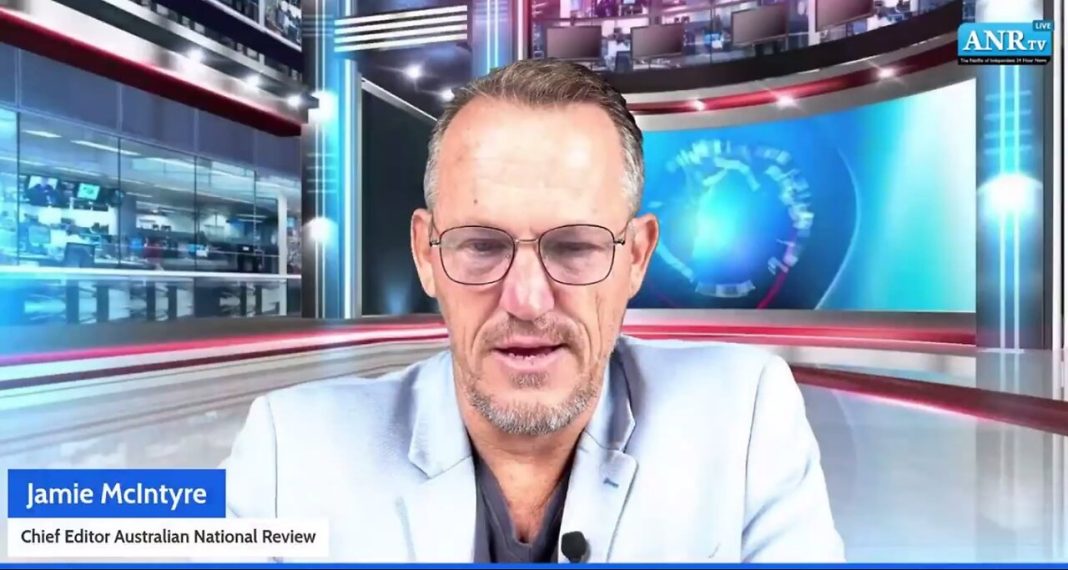
PART 3: Jamie McIntyre’s Response: The West Is Breaking Into Competing Factions
By Australian National Review Political Commentator – Jamie McIntyre
In response, Jamie McIntyre argued that the global landscape is not a simple battle between nationalism and globalism, but rather a conflict between competing elite factions.
According to McIntyre, one faction represents the traditional Davos-style globalist movement associated with institutions such as the WEF, multinational finance, and progressive internationalism. He argues this bloc has played a central role in conflicts such as the Ukraine war and broader efforts toward centralized global governance.
Opposing them, he claims, is a separate faction aligned with hardline Zionist interests centered around Israeli Prime Minister Benjamin Netanyahu and parts of the American conservative establishment, including Trump-aligned circles.
McIntyre further argued that movements such as “Q” or QAnon may have functioned either as a psychological operation or as an infiltrated movement designed to redirect populist anger away from structural power and toward factional conflict.
Where McIntyre diverges sharply from much Western political discourse is in his support for the rise of the BRICS bloc, including BRICS nations such as China and Russia.
He argues that BRICS represents the emergence of a multipolar world capable of breaking what he sees as decades of Western financial and military dominance. In his view, the United States under Trump had an opportunity to move toward a more independent and nationalist direction, potentially even aligning more closely with BRICS principles of sovereignty and reduced interventionism.
Instead, he believes entrenched geopolitical interests prevented that shift.
McIntyre also claims that parts of the American conservative movement became heavily influenced by pro-Israel political agendas, undermining the original “Make America Great Again” message of domestic renewal and non-intervention.
He points to his observations from political events in Washington during 2024, where he says support for Israel appeared deeply embedded within conservative political structures.
The Decline of Western Dominance?
The conversation ultimately arrives at a larger civilizational question: is the Western-led global order already collapsing?
For McIntyre, the answer is yes.
He argues that economically, politically, and culturally, the West is entering decline while nations such as China and Russia increasingly shape global power structures. Rising energy costs, industrial decline, debt expansion, and geopolitical fragmentation across Europe and North America are viewed as symptoms of this transition.
He further claims that the Ukraine war, sanctions regimes, and energy realignments accelerated the shift away from Western dominance while strengthening BRICS cooperation.
Within this framework, the emerging world is no longer unipolar. Instead of Washington dictating global rules, power is fragmenting into competing blocs.
Whether one agrees or disagrees with these perspectives, the conversation reflects a broader trend unfolding across the political spectrum: growing distrust of institutions, deep confusion over geopolitical narratives, and a widening belief that traditional left-versus-right politics no longer explains the forces shaping the modern world.
The result is a strange new political landscape where former conservatives attack global finance, former liberals question military alliances, populists distrust elections, and alternative media increasingly becomes the battlefield where competing versions of reality collide.
A century ago, geopolitics resembled chess.
Today, many feel it resembles a hall of mirrors.
Original source: https://x.com/jamiemcintyre21/status/2058346448790716690